Tuesday, February 21, 2012
Shrove Tuesday 2012
Fasting's Eve, Mardi Gras, Carnival, or Shrove Tuesday are names for this day before the beginning of Lent. The great fast of Lent begins tomorrow. Since pre-modern Europe observed what we would call a stringent fast (no meat, or dairy products from Ash Wednesday until Easter Sunday) the last day before the fast was a time for eating up meat, eggs, cheese, and drinking.
The names reflect that reality. The French "Mardi Gras" means "fat Tuesday." The Latin "Carne Vale" means "good-bye meat." The name "Shrove Tuesday" comes from the expectation that the pious would seek to be shriven (to confess) before undertaking the Lenten fast. "Fasting's Eve" is fairly clear.
Shrove Tuesday celebrations are continued to some extent in New Orleans' Mardi Gras, and Rio's Carnival. Drinking, feasting, and lewd behaviour were common.
But some Shrove Tuesday pastimes have passed away.
This used to be a great day for cockthreshing. A cock would be tethered to a pole, and selected participants would hurl stones at it in an effort to knock it down or kill it. It was also a good day for cockfighting, which continued to be popular into the 18th century. PETA-types would probably immolate themselves to stop that if it were common today (common, at least at the top of society: it is still widely, though secretly undertaken down at the lower levels).
Football games (we would call it soccer) were common on Shrove Tuesday in England. The difference was that in the 15th century, there were no teams and no rules. A football game was, therefore, a free-for-all. With the participants fueled by large amounts of alcohol and fresh meat, lots of people were injured. But it was all in good fun.
The Shrove Tuesday pancake is a slightly later tradition. The pancake requires milk, eggs, and butter, all of which had to be consumed before Lent started in that age before refrigeration. So the eating of pancakes became a Shrove Tuesday custom. Pancake races started at least 100 years before the Reformation. The Tossing of the Pancake at England's Westminister School is a natual development of the pancake tradition (a large pancake is tossed in part of the refectory, and the boy who comes out of a general scramble with the largest piece is given a reward).
Enjoy this last free day of Carnival. Tomorrow things take on a more sober cast.
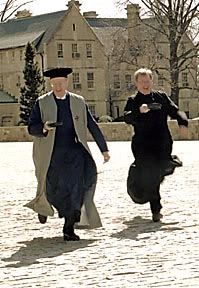
Shrove Tuesday Pancake Race. Those wild and wacky Anglicans! But wait, this is from the US National Cathedral website. Those wild ecumenical whatevers!
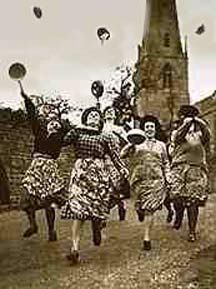
Here is a real Anglican Shrove Tuesday pancake race, from the UK.
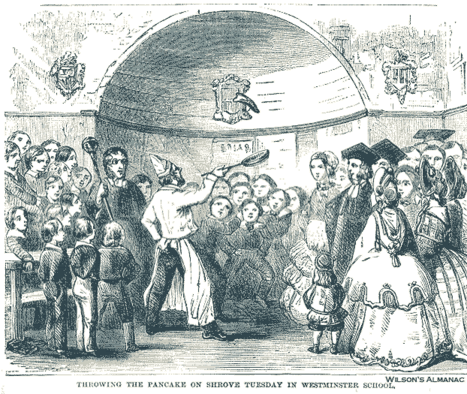
Throwing the Shrove Tuesday Pancake at Westminister School, London, 19th century. There was a scramble for it, as those who ended up with the pancake, or portions thereof if it was torn apart in the scrum, got a small cash prize.
More on Shrove Tuesday here at Wilson's Almanac.
And yet more, at Wikipedia.
But wait, there is even more Shrove Tuesday fun over at Fish Eaters.
How about a good pancake recipe?
Here's one from the files of Recta Ratio: The Yahoo Group (where there are over 500 recipes, many of them of seasonal interest, including many meatless meals for Lent):
2 eggs
1/2 c. whole milk
1/2 c. flour
2 T. brandy
2 T. butter
1 lime
Preheat oven to 400 degrees. Place an iron skillet in the oven and get it very hot. Beat eggs until fluffy. Add milk, brandy, and flour. Melt butter in the hot skillet, coating bottom and sides. Pour in the batter. Bake at 400 degrees for 30 mins (or until golden brown and puffy). Remove from oven and squeeze fresh lime juice over the pancake to deflate it. Dust with confectioners' sugar, maple syrup, and butter and serve immediately.

And what goes better with pancakes than

and lots of it? I dearly love my bacon, and the next six and a half weeks will be a sore trial going without it, or sausages, or corned beef hash, or....
The names reflect that reality. The French "Mardi Gras" means "fat Tuesday." The Latin "Carne Vale" means "good-bye meat." The name "Shrove Tuesday" comes from the expectation that the pious would seek to be shriven (to confess) before undertaking the Lenten fast. "Fasting's Eve" is fairly clear.
Shrove Tuesday celebrations are continued to some extent in New Orleans' Mardi Gras, and Rio's Carnival. Drinking, feasting, and lewd behaviour were common.
But some Shrove Tuesday pastimes have passed away.
This used to be a great day for cockthreshing. A cock would be tethered to a pole, and selected participants would hurl stones at it in an effort to knock it down or kill it. It was also a good day for cockfighting, which continued to be popular into the 18th century. PETA-types would probably immolate themselves to stop that if it were common today (common, at least at the top of society: it is still widely, though secretly undertaken down at the lower levels).
Football games (we would call it soccer) were common on Shrove Tuesday in England. The difference was that in the 15th century, there were no teams and no rules. A football game was, therefore, a free-for-all. With the participants fueled by large amounts of alcohol and fresh meat, lots of people were injured. But it was all in good fun.
The Shrove Tuesday pancake is a slightly later tradition. The pancake requires milk, eggs, and butter, all of which had to be consumed before Lent started in that age before refrigeration. So the eating of pancakes became a Shrove Tuesday custom. Pancake races started at least 100 years before the Reformation. The Tossing of the Pancake at England's Westminister School is a natual development of the pancake tradition (a large pancake is tossed in part of the refectory, and the boy who comes out of a general scramble with the largest piece is given a reward).
Enjoy this last free day of Carnival. Tomorrow things take on a more sober cast.
Shrove Tuesday Pancake Race. Those wild and wacky Anglicans! But wait, this is from the US National Cathedral website. Those wild ecumenical whatevers!
Here is a real Anglican Shrove Tuesday pancake race, from the UK.
Throwing the Shrove Tuesday Pancake at Westminister School, London, 19th century. There was a scramble for it, as those who ended up with the pancake, or portions thereof if it was torn apart in the scrum, got a small cash prize.
More on Shrove Tuesday here at Wilson's Almanac.
And yet more, at Wikipedia.
But wait, there is even more Shrove Tuesday fun over at Fish Eaters.
How about a good pancake recipe?
Here's one from the files of Recta Ratio: The Yahoo Group (where there are over 500 recipes, many of them of seasonal interest, including many meatless meals for Lent):
2 eggs
1/2 c. whole milk
1/2 c. flour
2 T. brandy
2 T. butter
1 lime
Preheat oven to 400 degrees. Place an iron skillet in the oven and get it very hot. Beat eggs until fluffy. Add milk, brandy, and flour. Melt butter in the hot skillet, coating bottom and sides. Pour in the batter. Bake at 400 degrees for 30 mins (or until golden brown and puffy). Remove from oven and squeeze fresh lime juice over the pancake to deflate it. Dust with confectioners' sugar, maple syrup, and butter and serve immediately.
And what goes better with pancakes than
and lots of it? I dearly love my bacon, and the next six and a half weeks will be a sore trial going without it, or sausages, or corned beef hash, or....
Labels: Shrovetide
Monday, February 20, 2012
Collop Monday 2012


Here we are, in the heart of Carnival, and today is a day historically devoted the the eating of collops (or chops) of meat. Get as much meat as you can now, since Ash Wednesday is looming. Beef, ham, pork, chicken, turkey; find it and devour it.
For traddies accept none of the Post-Conciliar, sissified, dumbed-down, "We-don't-want-to-make-it-too-hard-for-them," Friday-only abstention from meat. Lent itself is meatless, thoroughly meatless, from beginning to end. That is why this season is called Carnival, which is a contraction of the Latin "Carne Vale," or "good-bye, meat" (or "the flesh"). If our great-grandfathers could do it, so can we.
But if you are going to deprive yourself of meat for a very long time, and Ash Wednesday-through- Holy Saturday is quite a long time, you have to give it a good send-off. And that is why this season is here. Now is the time to make merry and pig out one last time, for starting on Ash Wednesday, we are fasting and abstaining.
But you say, "At least we have the Sundays"! No, not really. Sunday is never a fast day, true. But in a season of abstinence, while you can feast on the Sunday, you should feast on non-meat items, since you are still abstaining.
Oh the list of things to be saying good-bye to!
Gone will be gyros, and bacon-laden triple cheeseburgers, meatloaf, rashers of bacon, sausages, ham steaks, garlic roast beef, the Colonel's Strips, sirloin tips, chicken pasties, beef pasties, hot dogs, Beef Wellington, thick boneless center-cut pork chops, pork tenderloin roasts, pepperoni pizza, meatballs, tripe, pepperoni or sausage stromboli, Virginia Ham, chicken pot pie, sirloin, mushroom, and onion pie, turkey club sandwiches, ruebens, beef jerky, corned beef, pastrami, bologna sandwiches with Nathan's Coney island mustard on Miami Onion Rolls, hot Jamaican beef patties, chicken chowder, beef-based onion soup, cornish game hens, and even rabbit stew.
So many dear, much-loved mealtime companions!
Get ready for a lot of cheese and pasta, nuts and fruit and veggies (groan). Oh yeah, and there is peanut butter. Did I ever mention that most seafood I just won't touch? True. You get past mayo-laden tuna salad, some fried clams with no bellies, clam chowder, and maybe some shrimp with cocktail sauce, and I just won't go there. Even the de rigeur filet-o-fish with fries has well-defined limits.
Six and a half weeks of cheese pizza. Probably cold cheese pizza. And those little orange crackers with the peanut butter.
At least there are Cheez Waffies.
Tomorrow is Shrove Tuesday, or Pancake Tuesday. Can I have some meat on my pancakes?
Labels: Shrovetide
Sunday, February 19, 2012
Quinquagesima Sunday, Or Sunday In Shrovetide
From The Liturgical Year, by Abbot Prosper Gueranger, OSB:
The Church gives us today another subject for our meditation: it is the vocation of Abraham. When the waters of the deluge had subsided, and mankind had once more peopled the earth, the immorality, which had previously excited God's anger, again grew rife among men. Idolatry, too, into which the antediluvian race had not fallen, now showed itself, and human wickedness seemed thus to have reached the height of its malice. Foreseeing that the nations of the earth would fall into rebellion against Him, God resolved to select one whom should be preserved those sacred truths, of which the Gentiles were to lose sight. This new people were to originate from one man, who would be the father and model of all future believers. This was Abraham. His faith and devotedness merited for him that he should be chosen to be the father of the children of God, and the head of that spiritual family, to which belong all the elect of both the old and the new Testament.
It is necessary, therefore, that we should know Abraham, our father and our model. This is his grand characteristic: fidelity to God, submissiveness to His commands, abandonment and sacrifice of everything in order to obey His holy will. Such ought to be the prominent virtues of every Christian. Let us, then, study the life of our great patriarch, and learn, the lessons it teaches in Genesis 12.
Could the Christian have a finer model than this holy patriarch, whose docility and devotedness in following the call of his God are so perfect? We are forced to exclaim, with the holy fathers: 'O true Christian, even before Christ had come on the earth! Was preached! He was an apostolic man before the apostles existed!' God calls him: he leaves all things-his country, his kindred, his father's house-and he goes into an unknown land. God leads him, he is satisfied; he fears no difficulties; he never once looks back. Did the apostles themselves more? But see how grand is his reward! God says to him: 'In thee shall all the kindred of the earth be blessed.' This Chaldean is to give to the world Him that shall bless and it. Death will, it is true, close his eyes ages before the dawning of that day, when one of his race, who is to be born of a Virgin And be united personally with the divine Word, shall redeem all generations, past, present, and to come. But meanwhile, till heaven shall be thrown open to receive this Redeemer and the countless just who have won the crown, Abraham shall be honored, in the limbo of expectation, in a manner becoming his great virtue and merit. It is in his bosom, (1)-{St. Luke xvi: 22} that is, around him, that our first parents (having atoned for their sin by penance), Noah, Moses, David, and all the just, including poor Lazarus, received that rest and happiness, which were a foretaste of, and a preparation for, eternal bliss in Heaven. Thus is Abraham honored; thus does God requite the love and fidelity of them that serve Him.
When the fullness of time came, the Son of God, who was also Son of Abraham, declared His eternal Father's power, by saying that He was about to raise up a new progeny of Abraham's children from the very stones, that is, from the Gentiles (1)-{St. Matthew iii: 9}. We Christians are this new generation. But are we worthy children of our father? Let us listen to the apostle of the Gentiles: 'By faith, Abraham, when called (by God), obeyed to go out into a place, which he was to receive for an inheritance: And he went out not knowing whither he went. By faith, he abode in the land, dwelling in tents, with Isaac and Jacob, the co-heirs of the same promise; for he looked for a city that hath foundations, whose builder and maker is God'(2)-{Heb. Xi. 8-10}.
If, therefore, we be children of Abraham, we must, as the Church tells us during Septuagesima, look upon ourselves as exiles on the earth, and dwell by hope and desire in that true country of ours, from which we are now banished, but towards which we are each day drawing nigher, if, like Abraham, we are faithful in the various stations allotted us by our Lord. We are commanded to use this world as though we need it not,(3)-{1 Corinthians vii: 31} to have an abiding conviction of our not having here a lasting city (4)-{Hebrews xiii: 14} and of the misery and danger we incur when we forget that death is one day to separate us from every thing we possess in this life.
How far from being true children of Abraham are those Christians who spend this and the two following days in intemperance and dissipation, because Lent is soon to be upon us! We can easily understand how the simple manners of our Catholic forefathers could keep a leave-taking of the ordinary way of living, which Lent was to interrupt, and reconcile their innocent carnival with Christian gravity; just as we can understand how their rigorous observance of the laws of the Church for Lent would inspire certain festive customs at Easter. Even in our own times, a joyous Shrovetide is not to be altogether reprobated, provided the Christian sentiment of the approaching holy season of Lent be strong enough to check the evil tendency of an innocent custom would be perverted, and the forethought of penance could in no sense be considered as the prompter of our joyous farewell to ease and comforts.
While admitting all this, we would ask, what right or title have they to share in these Shrovetide rejoicings, whose Lent will pass and find them out of the Church, because they will not have complied with the precept of Easter Communion? And they, too, who claim dispensations from abstinence and fasting during Lent, and, for one reason or another, evade every penitential exercise during the solemn forty days of penance, And will find themselves at Easter as weighed down by the guilt and debt of their sins as they were on Ash Wednesday - what meaning, we would ask, can there possibly be in their feast-making at Shrovetide?
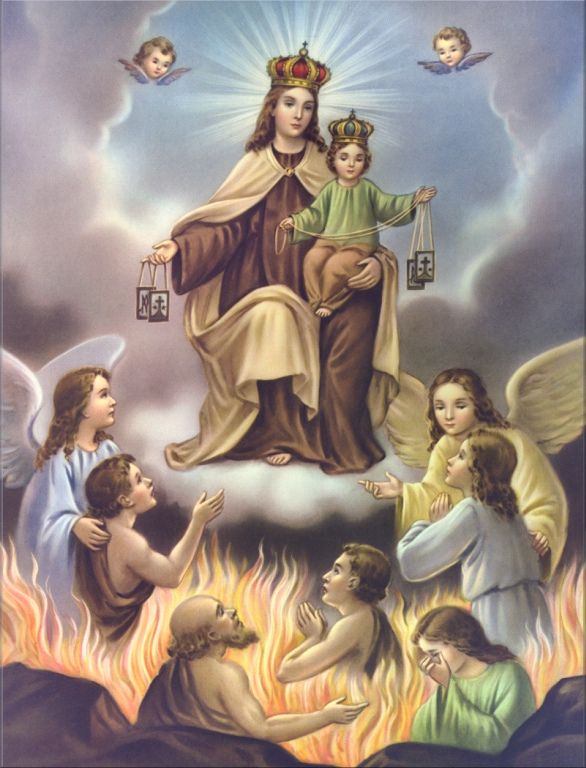
Oh! That Christians would stand on their guard against such delusions as these, and gain that holy liberty of children of God,(1)-{Romans viii: 21} which consists in not being slaves to flesh and blood, and preserves man from moral degradation! Let them remember that we are now in that holy season, when the Church denies herself her songs of holy joy, in order the more forcibly to remind us that we are living in a Babylon of spiritual danger, and to excite us to regain that genuine Christian spirit, which everything in the world around us is quietly undermining. If the disciples of Christ are necessitated, by the position they hold in society, to take part in the profane amusements of these few days before Lent, let it be with a heart deeply imbued with the maxims of the Gospel. If, for example, they are obliged to listen to the music of theatres and concerts, let them imitate St. Cecilia, who thus sang, in her heart, in the midst of the excitement of worldly harmonies; 'May my heart, O God, be pure, and let me not be confounded!' Above all, let them not countenance certain dances, which the world is so eloquent in defending, because so evidently according to its own spirit; and therefore they who encourage they will be severely judged by Him, who has already pronounced woe upon the world. Lastly, let those who must go, on these days, and mingle in the company of worldlings, be guided by St. Francis of Sales, who advises them to think, from time to time, on such considerations as these: that while all these frivolous, and often dangerous, amusements are going on, there are countless souls being tormented in the fire of hell, on account of the sins they committed on similar occasions; that, at that very hour of the night, there are many holy religious depriving themselves of sleep in order to sing the divine praises and implore God's mercy upon the world, and upon them that are wasting their time in its vanities; that there are thousands in the agonies of death, while all that gaiety is going on; that God and His angels are attentively looking upon this thoughtless group and finally, that life is passing away, and death so much nearer each moment(1)-{Introduction to a Devout Life,' part iii. Chapter xxiii}.
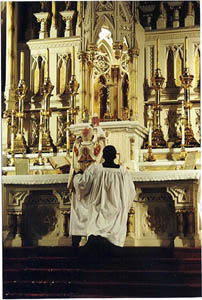
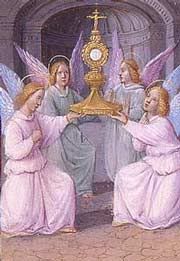
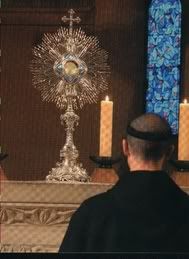
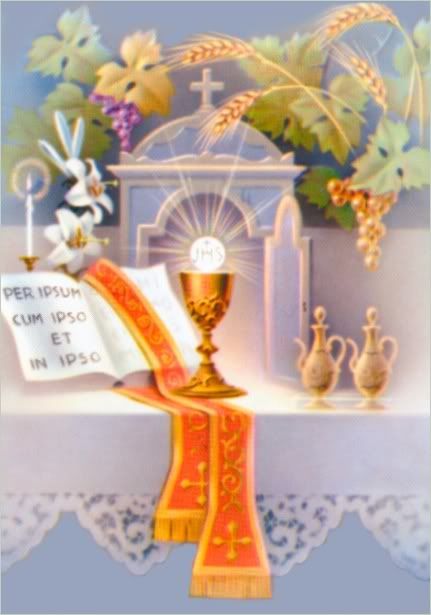
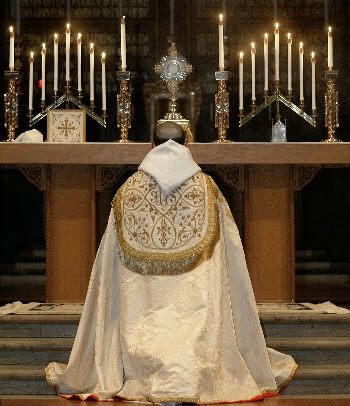
We grant that, on these three days immediately preceding the penitential season of Lent, some provision was necessary to be made for those countless souls, who seem scarce able to live without some excitement. The Church supplies this want. She gives a substitute for frivolous amusements and dangerous pleasures; and those of her children upon whom faith has not lost its influence, will find, in what she offers them, a feast surpassing all earthly enjoyments, and a means whereby to make amends to God for the insults offered to His divine Majesty during these days of carnival. The Lamb, that taketh away the sins of the world, is exposed upon our altars. Here, on this His throne of mercy, He receives the homage of them who come to adore Him, and acknowledge Him for their King; He accepts the repentance of those who come to tell Him how grieved they are at having ever followed any other master but Him; He offers Himself to His eternal Father for poor sinners, who not only treat His favors with indifference, but seem to have made a resolution to offend Him during these days more than at any other period of the year.
It was the pious Cardinal Gabriel Paleotti, archbishop of Bologna, who first originated the admirable devotion of the Forty Hours. He was a contemporary of St. Charles Borromeo, and, like him, was eminent for his pastoral ZEAL. His object in this solemn Exposition of the most blessed Sacrament was to offer to the divine Majesty some compensation for the sins of men, and, at the very time when the world was busiest in deserving His anger, to appease it by the sight of His own Son, the Mediator between heaven and earth. St. Charles immediately introduced the devotion into his own diocese and province. This was in the sixteenth century. Later on, that is, in the eighteenth century, Prosper Lambertini was archbishop of Bologna; he zealously continued the pious design of his ancient predecessor, Paleotti, by encouraging his flock to devotion towards the blessed Sacrament during the three days of carnival; and when he was made Pope, under the name of Benedict XIV, he granted many Indulgences to all who, during these days, should visit our Lord in this mystery of His love, and should pray for the pardon of sinners. This favor was, at first, restricted to the faithful of the Papal States; but in the year 1765 it was extended, by Pope Clement XIII, to the universal Church. Thus, the Forty Hours' Devotion has spread throughout the whole world, and become one of the most solemn expressions of Catholic piety. Let us, then, who have the opportunity, profit by it during these last three days of our preparation for Lent. Let us, like Abraham, retire from the distracting dangers of the world, and seek the Lord our God. Let us go apart, for at least one short hour, from the dissipation of earthly enjoyments, and, kneeling in the presence of our Jesus, merit the grace to keep our hearts innocent and detached, whilst sharing in those we cannot avoid.
The Church gives us today another subject for our meditation: it is the vocation of Abraham. When the waters of the deluge had subsided, and mankind had once more peopled the earth, the immorality, which had previously excited God's anger, again grew rife among men. Idolatry, too, into which the antediluvian race had not fallen, now showed itself, and human wickedness seemed thus to have reached the height of its malice. Foreseeing that the nations of the earth would fall into rebellion against Him, God resolved to select one whom should be preserved those sacred truths, of which the Gentiles were to lose sight. This new people were to originate from one man, who would be the father and model of all future believers. This was Abraham. His faith and devotedness merited for him that he should be chosen to be the father of the children of God, and the head of that spiritual family, to which belong all the elect of both the old and the new Testament.
It is necessary, therefore, that we should know Abraham, our father and our model. This is his grand characteristic: fidelity to God, submissiveness to His commands, abandonment and sacrifice of everything in order to obey His holy will. Such ought to be the prominent virtues of every Christian. Let us, then, study the life of our great patriarch, and learn, the lessons it teaches in Genesis 12.
Could the Christian have a finer model than this holy patriarch, whose docility and devotedness in following the call of his God are so perfect? We are forced to exclaim, with the holy fathers: 'O true Christian, even before Christ had come on the earth! Was preached! He was an apostolic man before the apostles existed!' God calls him: he leaves all things-his country, his kindred, his father's house-and he goes into an unknown land. God leads him, he is satisfied; he fears no difficulties; he never once looks back. Did the apostles themselves more? But see how grand is his reward! God says to him: 'In thee shall all the kindred of the earth be blessed.' This Chaldean is to give to the world Him that shall bless and it. Death will, it is true, close his eyes ages before the dawning of that day, when one of his race, who is to be born of a Virgin And be united personally with the divine Word, shall redeem all generations, past, present, and to come. But meanwhile, till heaven shall be thrown open to receive this Redeemer and the countless just who have won the crown, Abraham shall be honored, in the limbo of expectation, in a manner becoming his great virtue and merit. It is in his bosom, (1)-{St. Luke xvi: 22} that is, around him, that our first parents (having atoned for their sin by penance), Noah, Moses, David, and all the just, including poor Lazarus, received that rest and happiness, which were a foretaste of, and a preparation for, eternal bliss in Heaven. Thus is Abraham honored; thus does God requite the love and fidelity of them that serve Him.
When the fullness of time came, the Son of God, who was also Son of Abraham, declared His eternal Father's power, by saying that He was about to raise up a new progeny of Abraham's children from the very stones, that is, from the Gentiles (1)-{St. Matthew iii: 9}. We Christians are this new generation. But are we worthy children of our father? Let us listen to the apostle of the Gentiles: 'By faith, Abraham, when called (by God), obeyed to go out into a place, which he was to receive for an inheritance: And he went out not knowing whither he went. By faith, he abode in the land, dwelling in tents, with Isaac and Jacob, the co-heirs of the same promise; for he looked for a city that hath foundations, whose builder and maker is God'(2)-{Heb. Xi. 8-10}.
If, therefore, we be children of Abraham, we must, as the Church tells us during Septuagesima, look upon ourselves as exiles on the earth, and dwell by hope and desire in that true country of ours, from which we are now banished, but towards which we are each day drawing nigher, if, like Abraham, we are faithful in the various stations allotted us by our Lord. We are commanded to use this world as though we need it not,(3)-{1 Corinthians vii: 31} to have an abiding conviction of our not having here a lasting city (4)-{Hebrews xiii: 14} and of the misery and danger we incur when we forget that death is one day to separate us from every thing we possess in this life.
How far from being true children of Abraham are those Christians who spend this and the two following days in intemperance and dissipation, because Lent is soon to be upon us! We can easily understand how the simple manners of our Catholic forefathers could keep a leave-taking of the ordinary way of living, which Lent was to interrupt, and reconcile their innocent carnival with Christian gravity; just as we can understand how their rigorous observance of the laws of the Church for Lent would inspire certain festive customs at Easter. Even in our own times, a joyous Shrovetide is not to be altogether reprobated, provided the Christian sentiment of the approaching holy season of Lent be strong enough to check the evil tendency of an innocent custom would be perverted, and the forethought of penance could in no sense be considered as the prompter of our joyous farewell to ease and comforts.
While admitting all this, we would ask, what right or title have they to share in these Shrovetide rejoicings, whose Lent will pass and find them out of the Church, because they will not have complied with the precept of Easter Communion? And they, too, who claim dispensations from abstinence and fasting during Lent, and, for one reason or another, evade every penitential exercise during the solemn forty days of penance, And will find themselves at Easter as weighed down by the guilt and debt of their sins as they were on Ash Wednesday - what meaning, we would ask, can there possibly be in their feast-making at Shrovetide?
Oh! That Christians would stand on their guard against such delusions as these, and gain that holy liberty of children of God,(1)-{Romans viii: 21} which consists in not being slaves to flesh and blood, and preserves man from moral degradation! Let them remember that we are now in that holy season, when the Church denies herself her songs of holy joy, in order the more forcibly to remind us that we are living in a Babylon of spiritual danger, and to excite us to regain that genuine Christian spirit, which everything in the world around us is quietly undermining. If the disciples of Christ are necessitated, by the position they hold in society, to take part in the profane amusements of these few days before Lent, let it be with a heart deeply imbued with the maxims of the Gospel. If, for example, they are obliged to listen to the music of theatres and concerts, let them imitate St. Cecilia, who thus sang, in her heart, in the midst of the excitement of worldly harmonies; 'May my heart, O God, be pure, and let me not be confounded!' Above all, let them not countenance certain dances, which the world is so eloquent in defending, because so evidently according to its own spirit; and therefore they who encourage they will be severely judged by Him, who has already pronounced woe upon the world. Lastly, let those who must go, on these days, and mingle in the company of worldlings, be guided by St. Francis of Sales, who advises them to think, from time to time, on such considerations as these: that while all these frivolous, and often dangerous, amusements are going on, there are countless souls being tormented in the fire of hell, on account of the sins they committed on similar occasions; that, at that very hour of the night, there are many holy religious depriving themselves of sleep in order to sing the divine praises and implore God's mercy upon the world, and upon them that are wasting their time in its vanities; that there are thousands in the agonies of death, while all that gaiety is going on; that God and His angels are attentively looking upon this thoughtless group and finally, that life is passing away, and death so much nearer each moment(1)-{Introduction to a Devout Life,' part iii. Chapter xxiii}.
We grant that, on these three days immediately preceding the penitential season of Lent, some provision was necessary to be made for those countless souls, who seem scarce able to live without some excitement. The Church supplies this want. She gives a substitute for frivolous amusements and dangerous pleasures; and those of her children upon whom faith has not lost its influence, will find, in what she offers them, a feast surpassing all earthly enjoyments, and a means whereby to make amends to God for the insults offered to His divine Majesty during these days of carnival. The Lamb, that taketh away the sins of the world, is exposed upon our altars. Here, on this His throne of mercy, He receives the homage of them who come to adore Him, and acknowledge Him for their King; He accepts the repentance of those who come to tell Him how grieved they are at having ever followed any other master but Him; He offers Himself to His eternal Father for poor sinners, who not only treat His favors with indifference, but seem to have made a resolution to offend Him during these days more than at any other period of the year.
It was the pious Cardinal Gabriel Paleotti, archbishop of Bologna, who first originated the admirable devotion of the Forty Hours. He was a contemporary of St. Charles Borromeo, and, like him, was eminent for his pastoral ZEAL. His object in this solemn Exposition of the most blessed Sacrament was to offer to the divine Majesty some compensation for the sins of men, and, at the very time when the world was busiest in deserving His anger, to appease it by the sight of His own Son, the Mediator between heaven and earth. St. Charles immediately introduced the devotion into his own diocese and province. This was in the sixteenth century. Later on, that is, in the eighteenth century, Prosper Lambertini was archbishop of Bologna; he zealously continued the pious design of his ancient predecessor, Paleotti, by encouraging his flock to devotion towards the blessed Sacrament during the three days of carnival; and when he was made Pope, under the name of Benedict XIV, he granted many Indulgences to all who, during these days, should visit our Lord in this mystery of His love, and should pray for the pardon of sinners. This favor was, at first, restricted to the faithful of the Papal States; but in the year 1765 it was extended, by Pope Clement XIII, to the universal Church. Thus, the Forty Hours' Devotion has spread throughout the whole world, and become one of the most solemn expressions of Catholic piety. Let us, then, who have the opportunity, profit by it during these last three days of our preparation for Lent. Let us, like Abraham, retire from the distracting dangers of the world, and seek the Lord our God. Let us go apart, for at least one short hour, from the dissipation of earthly enjoyments, and, kneeling in the presence of our Jesus, merit the grace to keep our hearts innocent and detached, whilst sharing in those we cannot avoid.
Labels: Septuagesima, Shrovetide, The Liturgical Year
Tuesday, March 08, 2011
Shrove Tuesday 2011
Fasting's Eve, Mardi Gras, Carnival, or Shrove Tuesday are names for this day before the beginning of Lent. The great fast of Lent begins tomorrow. Since pre-modern Europe observed what we would call a stringent fast (no meat, or dairy products from Ash Wednesday until Easter Sunday) the last day before the fast was a time for eating up meat, eggs, cheese, and drinking.
The names reflect that reality. The French "Mardi Gras" means "fat Tuesday." The Latin "Carne Vale" means "good-bye meat." The name "Shrove Tuesday" comes from the expectation that the pious would seek to be shriven (to confess) before undertaking the Lenten fast. "Fasting's Eve" is fairly clear.
Shrove Tuesday celebrations are continued to some extent in New Orleans' Mardi Gras, and Rio's Carnival. Drinking, feasting, and lewd behaviour were common.
But some Shrove Tuesday pastimes have passed away.
This used to be a great day for cockthreshing. A cock would be tethered to a pole, and selected participants would hurl stones at it in an effort to knock it down or kill it. It was also a good day for cockfighting, which continued to be popular into the 18th century. PETA-types would probably immolate themselves to stop that if it were common today (common, at least at the top of society: it is still widely, though secretly undertaken down at the lower levels).
Football games (we would call it soccer) were common on Shrove Tuesday in England. The difference was that in the 15th century, there were no teams and no rules. A football game was, therefore, a free-for-all. With the participants fueled by large amounts of alcohol and fresh meat, lots of people were injured. But it was all in good fun.
The Shrove Tuesday pancake is a slightly later tradition. The pancake requires milk, eggs, and butter, all of which had to be consumed before Lent started in that age before refrigeration. So the eating of pancakes became a Shrove Tuesday custom. Pancake races started at least 100 years before the Reformation. The Tossing of the Pancake at England's Westminister School is a natual development of the pancake tradition (a large pancake is tossed in part of the refectory, and the boy who comes out of a general scramble with the largest piece is given a reward).
Enjoy this last free day of Carnival. Tomorrow things take on a more sober cast.
Shrove Tuesday Pancake Race. Those wild and wacky Anglicans! But wait, this is from the US National Cathedral website. Those wild ecumenical whatevers!
Here is a real Anglican Shrove Tuesday pancake race, from the UK.
Throwing the Shrove Tuesday Pancake at Westminister School, London, 19th century. There was a scramble for it, as those who ended up with the pancake, or portions thereof if it was torn apart in the scrum, got a small cash prize.
More on Shrove Tuesday here at Wilson's Almanac.
And yet more, at Wikipedia.
But wait, there is even more Shrove Tuesday fun over at Fish Eaters.
How about a good pancake recipe?
Here's one from the files of Recta Ratio: The Yahoo Group (where there are over 500 recipes, many of them of seasonal interest, including many meatless meals for Lent):
2 eggs
1/2 c. whole milk
1/2 c. flour
2 T. brandy
2 T. butter
1 lime
Preheat oven to 400 degrees. Place an iron skillet in the oven and get it very hot. Beat eggs until fluffy. Add milk, brandy, and flour. Melt butter in the hot skillet, coating bottom and sides. Pour in the batter. Bake at 400 degrees for 30 mins (or until golden brown and puffy). Remove from oven and squeeze fresh lime juice over the pancake to deflate it. Dust with confectioners' sugar, maple syrup, and butter and serve immediately.
And what goes better with pancakes than
and lots of it? I dearly love my bacon, and the next six and a half weeks will be a sore trial going without it, or sausages, or corned beef hash, or....
The names reflect that reality. The French "Mardi Gras" means "fat Tuesday." The Latin "Carne Vale" means "good-bye meat." The name "Shrove Tuesday" comes from the expectation that the pious would seek to be shriven (to confess) before undertaking the Lenten fast. "Fasting's Eve" is fairly clear.
Shrove Tuesday celebrations are continued to some extent in New Orleans' Mardi Gras, and Rio's Carnival. Drinking, feasting, and lewd behaviour were common.
But some Shrove Tuesday pastimes have passed away.
This used to be a great day for cockthreshing. A cock would be tethered to a pole, and selected participants would hurl stones at it in an effort to knock it down or kill it. It was also a good day for cockfighting, which continued to be popular into the 18th century. PETA-types would probably immolate themselves to stop that if it were common today (common, at least at the top of society: it is still widely, though secretly undertaken down at the lower levels).
Football games (we would call it soccer) were common on Shrove Tuesday in England. The difference was that in the 15th century, there were no teams and no rules. A football game was, therefore, a free-for-all. With the participants fueled by large amounts of alcohol and fresh meat, lots of people were injured. But it was all in good fun.
The Shrove Tuesday pancake is a slightly later tradition. The pancake requires milk, eggs, and butter, all of which had to be consumed before Lent started in that age before refrigeration. So the eating of pancakes became a Shrove Tuesday custom. Pancake races started at least 100 years before the Reformation. The Tossing of the Pancake at England's Westminister School is a natual development of the pancake tradition (a large pancake is tossed in part of the refectory, and the boy who comes out of a general scramble with the largest piece is given a reward).
Enjoy this last free day of Carnival. Tomorrow things take on a more sober cast.
Shrove Tuesday Pancake Race. Those wild and wacky Anglicans! But wait, this is from the US National Cathedral website. Those wild ecumenical whatevers!
Here is a real Anglican Shrove Tuesday pancake race, from the UK.
Throwing the Shrove Tuesday Pancake at Westminister School, London, 19th century. There was a scramble for it, as those who ended up with the pancake, or portions thereof if it was torn apart in the scrum, got a small cash prize.
More on Shrove Tuesday here at Wilson's Almanac.
And yet more, at Wikipedia.
But wait, there is even more Shrove Tuesday fun over at Fish Eaters.
How about a good pancake recipe?
Here's one from the files of Recta Ratio: The Yahoo Group (where there are over 500 recipes, many of them of seasonal interest, including many meatless meals for Lent):
2 eggs
1/2 c. whole milk
1/2 c. flour
2 T. brandy
2 T. butter
1 lime
Preheat oven to 400 degrees. Place an iron skillet in the oven and get it very hot. Beat eggs until fluffy. Add milk, brandy, and flour. Melt butter in the hot skillet, coating bottom and sides. Pour in the batter. Bake at 400 degrees for 30 mins (or until golden brown and puffy). Remove from oven and squeeze fresh lime juice over the pancake to deflate it. Dust with confectioners' sugar, maple syrup, and butter and serve immediately.
And what goes better with pancakes than
and lots of it? I dearly love my bacon, and the next six and a half weeks will be a sore trial going without it, or sausages, or corned beef hash, or....
Labels: Carnival, Septuagesima, Shrovetide
Monday, March 07, 2011
Collop Monday 2011
Here we are, in the heart of Carnival, and today is a day historically devoted the the eating of collops (or chops) of meat. Get as much meat as you can now, since Ash Wednesday is looming. Beef, ham, pork, chicken, turkey; find it and devour it.
For traddies accept none of the Post-Conciliar, sissified, dumbed-down, "We-don't-want-to-make-it-too-hard-for-them," Friday-only abstention from meat. Lent itself is meatless, thoroughly meatless, from beginning to end. That is why this season is called Carnival, which is a contraction of the Latin "Carne Vale," or "good-bye, meat" (or "the flesh"). If our great-grandfathers could do it, so can we.
But if you are going to deprive yourself of meat for a very long time, and Ash Wednesday-through- Holy Saturday is quite a long time, you have to give it a good send-off. And that is why this season is here. Now is the time to make merry and pig out one last time, for starting on Ash Wednesday, we are fasting and abstaining.
But you say, "At least we have the Sundays"! No, not really. Sunday is never a fast day, true. But in a season of abstinence, while you can feast on the Sunday, you should feast on non-meat items, since you are still abstaining.
Oh the list of things to be saying good-bye to!
Gone will be gyros, and bacon-laden triple cheeseburgers, meatloaf, rashers of bacon, sausages, ham steaks, garlic roast beef, the Colonel's Strips, sirloin tips, chicken pasties, beef pasties, hot dogs, Beef Wellington, thick boneless center-cut pork chops, pork tenderloin roasts, pepperoni pizza, meatballs, tripe, pepperoni or sausage stromboli, Virginia Ham, chicken pot pie, sirloin, mushroom, and onion pie, turkey club sandwiches, ruebens, beef jerky, corned beef, pastrami, bologna sandwiches with Nathan's Coney island mustard on Miami Onion Rolls, hot Jamaican beef patties, chicken chowder, beef-based onion soup, cornish game hens, and even rabbit stew.
So many dear, much-loved mealtime companions!
Get ready for a lot of cheese and pasta, nuts and fruit and veggies (groan). Oh yeah, and there is peanut butter. Did I ever mention that most seafood I just won't touch? True. You get past mayo-laden tuna salad, some fried clams with no bellies, clam chowder, and maybe some shrimp with cocktail sauce, and I just won't go there. Even the de rigeur filet-o-fish with fries has well-defined limits.
Six and a half weeks of cheese pizza. Probably cold cheese pizza. And those little orange crackers with the peanut butter.
At least there are Cheez Waffies.
Tomorrow is Shrove Tuesday, or Pancake Tuesday. Can I have some meat on my pancakes?
Labels: Carnival, Septuagesima, Shrovetide
Sunday, March 06, 2011
Quinquagesima Sunday, Or Sunday In Shrovetide
From The Liturgical Year, by Abbot Prosper Gueranger, OSB:
The Church gives us today another subject for our meditation: it is the vocation of Abraham. When the waters of the deluge had subsided, and mankind had once more peopled the earth, the immorality, which had previously excited God's anger, again grew rife among men. Idolatry, too, into which the antediluvian race had not fallen, now showed itself, and human wickedness seemed thus to have reached the height of its malice. Foreseeing that the nations of the earth would fall into rebellion against Him, God resolved to select one whom should be preserved those sacred truths, of which the Gentiles were to lose sight. This new people were to originate from one man, who would be the father and model of all future believers. This was Abraham. His faith and devotedness merited for him that he should be chosen to be the father of the children of God, and the head of that spiritual family, to which belong all the elect of both the old and the new Testament.
It is necessary, therefore, that we should know Abraham, our father and our model. This is his grand characteristic: fidelity to God, submissiveness to His commands, abandonment and sacrifice of everything in order to obey His holy will. Such ought to be the prominent virtues of every Christian. Let us, then, study the life of our great patriarch, and learn, the lessons it teaches in Genesis 12.
Could the Christian have a finer model than this holy patriarch, whose docility and devotedness in following the call of his God are so perfect? We are forced to exclaim, with the holy fathers: 'O true Christian, even before Christ had come on the earth! Was preached! He was an apostolic man before the apostles existed!' God calls him: he leaves all things-his country, his kindred, his father's house-and he goes into an unknown land. God leads him, he is satisfied; he fears no difficulties; he never once looks back. Did the apostles themselves more? But see how grand is his reward! God says to him: 'In thee shall all the kindred of the earth be blessed.' This Chaldean is to give to the world Him that shall bless and it. Death will, it is true, close his eyes ages before the dawning of that day, when one of his race, who is to be born of a Virgin And be united personally with the divine Word, shall redeem all generations, past, present, and to come. But meanwhile, till heaven shall be thrown open to receive this Redeemer and the countless just who have won the crown, Abraham shall be honored, in the limbo of expectation, in a manner becoming his great virtue and merit. It is in his bosom, (1)-{St. Luke xvi: 22} that is, around him, that our first parents (having atoned for their sin by penance), Noah, Moses, David, and all the just, including poor Lazarus, received that rest and happiness, which were a foretaste of, and a preparation for, eternal bliss in Heaven. Thus is Abraham honored; thus does God requite the love and fidelity of them that serve Him.
When the fullness of time came, the Son of God, who was also Son of Abraham, declared His eternal Father's power, by saying that He was about to raise up a new progeny of Abraham's children from the very stones, that is, from the Gentiles (1)-{St. Matthew iii: 9}. We Christians are this new generation. But are we worthy children of our father? Let us listen to the apostle of the Gentiles: 'By faith, Abraham, when called (by God), obeyed to go out into a place, which he was to receive for an inheritance: And he went out not knowing whither he went. By faith, he abode in the land, dwelling in tents, with Isaac and Jacob, the co-heirs of the same promise; for he looked for a city that hath foundations, whose builder and maker is God'(2)-{Heb. Xi. 8-10}.
If, therefore, we be children of Abraham, we must, as the Church tells us during Septuagesima, look upon ourselves as exiles on the earth, and dwell by hope and desire in that true country of ours, from which we are now banished, but towards which we are each day drawing nigher, if, like Abraham, we are faithful in the various stations allotted us by our Lord. We are commanded to use this world as though we need it not,(3)-{1 Corinthians vii: 31} to have an abiding conviction of our not having here a lasting city (4)-{Hebrews xiii: 14} and of the misery and danger we incur when we forget that death is one day to separate us from every thing we possess in this life.
How far from being true children of Abraham are those Christians who spend this and the two following days in intemperance and dissipation, because Lent is soon to be upon us! We can easily understand how the simple manners of our Catholic forefathers could keep a leave-taking of the ordinary way of living, which Lent was to interrupt, and reconcile their innocent carnival with Christian gravity; just as we can understand how their rigorous observance of the laws of the Church for Lent would inspire certain festive customs at Easter. Even in our own times, a joyous Shrovetide is not to be altogether reprobated, provided the Christian sentiment of the approaching holy season of Lent be strong enough to check the evil tendency of an innocent custom would be perverted, and the forethought of penance could in no sense be considered as the prompter of our joyous farewell to ease and comforts.
While admitting all this, we would ask, what right or title have they to share in these Shrovetide rejoicings, whose Lent will pass and find them out of the Church, because they will not have complied with the precept of Easter Communion? And they, too, who claim dispensations from abstinence and fasting during Lent, and, for one reason or another, evade every penitential exercise during the solemn forty days of penance, And will find themselves at Easter as weighed down by the guilt and debt of their sins as they were on Ash Wednesday - what meaning, we would ask, can there possibly be in their feast-making at Shrovetide?
Oh! That Christians would stand on their guard against such delusions as these, and gain that holy liberty of children of God,(1)-{Romans viii: 21} which consists in not being slaves to flesh and blood, and preserves man from moral degradation! Let them remember that we are now in that holy season, when the Church denies herself her songs of holy joy, in order the more forcibly to remind us that we are living in a Babylon of spiritual danger, and to excite us to regain that genuine Christian spirit, which everything in the world around us is quietly undermining. If the disciples of Christ are necessitated, by the position they hold in society, to take part in the profane amusements of these few days before Lent, let it be with a heart deeply imbued with the maxims of the Gospel. If, for example, they are obliged to listen to the music of theatres and concerts, let them imitate St. Cecilia, who thus sang, in her heart, in the midst of the excitement of worldly harmonies; 'May my heart, O God, be pure, and let me not be confounded!' Above all, let them not countenance certain dances, which the world is so eloquent in defending, because so evidently according to its own spirit; and therefore they who encourage they will be severely judged by Him, who has already pronounced woe upon the world. Lastly, let those who must go, on these days, and mingle in the company of worldlings, be guided by St. Francis of Sales, who advises them to think, from time to time, on such considerations as these: that while all these frivolous, and often dangerous, amusements are going on, there are countless souls being tormented in the fire of hell, on account of the sins they committed on similar occasions; that, at that very hour of the night, there are many holy religious depriving themselves of sleep in order to sing the divine praises and implore God's mercy upon the world, and upon them that are wasting their time in its vanities; that there are thousands in the agonies of death, while all that gaiety is going on; that God and His angels are attentively looking upon this thoughtless group and finally, that life is passing away, and death so much nearer each moment(1)-{Introduction to a Devout Life,' part iii. Chapter xxiii}.
We grant that, on these three days immediately preceding the penitential season of Lent, some provision was necessary to be made for those countless souls, who seem scarce able to live without some excitement. The Church supplies this want. She gives a substitute for frivolous amusements and dangerous pleasures; and those of her children upon whom faith has not lost its influence, will find, in what she offers them, a feast surpassing all earthly enjoyments, and a means whereby to make amends to God for the insults offered to His divine Majesty during these days of carnival. The Lamb, that taketh away the sins of the world, is exposed upon our altars. Here, on this His throne of mercy, He receives the homage of them who come to adore Him, and acknowledge Him for their King; He accepts the repentance of those who come to tell Him how grieved they are at having ever followed any other master but Him; He offers Himself to His eternal Father for poor sinners, who not only treat His favors with indifference, but seem to have made a resolution to offend Him during these days more than at any other period of the year.
It was the pious Cardinal Gabriel Paleotti, archbishop of Bologna, who first originated the admirable devotion of the Forty Hours. He was a contemporary of St. Charles Borromeo, and, like him, was eminent for his pastoral ZEAL. His object in this solemn Exposition of the most blessed Sacrament was to offer to the divine Majesty some compensation for the sins of men, and, at the very time when the world was busiest in deserving His anger, to appease it by the sight of His own Son, the Mediator between heaven and earth. St. Charles immediately introduced the devotion into his own diocese and province. This was in the sixteenth century. Later on, that is, in the eighteenth century, Prosper Lambertini was archbishop of Bologna; he zealously continued the pious design of his ancient predecessor, Paleotti, by encouraging his flock to devotion towards the blessed Sacrament during the three days of carnival; and when he was made Pope, under the name of Benedict XIV, he granted many Indulgences to all who, during these days, should visit our Lord in this mystery of His love, and should pray for the pardon of sinners. This favor was, at first, restricted to the faithful of the Papal States; but in the year 1765 it was extended, by Pope Clement XIII, to the universal Church. Thus, the Forty Hours' Devotion has spread throughout the whole world, and become one of the most solemn expressions of Catholic piety. Let us, then, who have the opportunity, profit by it during these last three days of our preparation for Lent. Let us, like Abraham, retire from the distracting dangers of the world, and seek the Lord our God. Let us go apart, for at least one short hour, from the dissipation of earthly enjoyments, and, kneeling in the presence of our Jesus, merit the grace to keep our hearts innocent and detached, whilst sharing in those we cannot avoid.
The Church gives us today another subject for our meditation: it is the vocation of Abraham. When the waters of the deluge had subsided, and mankind had once more peopled the earth, the immorality, which had previously excited God's anger, again grew rife among men. Idolatry, too, into which the antediluvian race had not fallen, now showed itself, and human wickedness seemed thus to have reached the height of its malice. Foreseeing that the nations of the earth would fall into rebellion against Him, God resolved to select one whom should be preserved those sacred truths, of which the Gentiles were to lose sight. This new people were to originate from one man, who would be the father and model of all future believers. This was Abraham. His faith and devotedness merited for him that he should be chosen to be the father of the children of God, and the head of that spiritual family, to which belong all the elect of both the old and the new Testament.
It is necessary, therefore, that we should know Abraham, our father and our model. This is his grand characteristic: fidelity to God, submissiveness to His commands, abandonment and sacrifice of everything in order to obey His holy will. Such ought to be the prominent virtues of every Christian. Let us, then, study the life of our great patriarch, and learn, the lessons it teaches in Genesis 12.
Could the Christian have a finer model than this holy patriarch, whose docility and devotedness in following the call of his God are so perfect? We are forced to exclaim, with the holy fathers: 'O true Christian, even before Christ had come on the earth! Was preached! He was an apostolic man before the apostles existed!' God calls him: he leaves all things-his country, his kindred, his father's house-and he goes into an unknown land. God leads him, he is satisfied; he fears no difficulties; he never once looks back. Did the apostles themselves more? But see how grand is his reward! God says to him: 'In thee shall all the kindred of the earth be blessed.' This Chaldean is to give to the world Him that shall bless and it. Death will, it is true, close his eyes ages before the dawning of that day, when one of his race, who is to be born of a Virgin And be united personally with the divine Word, shall redeem all generations, past, present, and to come. But meanwhile, till heaven shall be thrown open to receive this Redeemer and the countless just who have won the crown, Abraham shall be honored, in the limbo of expectation, in a manner becoming his great virtue and merit. It is in his bosom, (1)-{St. Luke xvi: 22} that is, around him, that our first parents (having atoned for their sin by penance), Noah, Moses, David, and all the just, including poor Lazarus, received that rest and happiness, which were a foretaste of, and a preparation for, eternal bliss in Heaven. Thus is Abraham honored; thus does God requite the love and fidelity of them that serve Him.
When the fullness of time came, the Son of God, who was also Son of Abraham, declared His eternal Father's power, by saying that He was about to raise up a new progeny of Abraham's children from the very stones, that is, from the Gentiles (1)-{St. Matthew iii: 9}. We Christians are this new generation. But are we worthy children of our father? Let us listen to the apostle of the Gentiles: 'By faith, Abraham, when called (by God), obeyed to go out into a place, which he was to receive for an inheritance: And he went out not knowing whither he went. By faith, he abode in the land, dwelling in tents, with Isaac and Jacob, the co-heirs of the same promise; for he looked for a city that hath foundations, whose builder and maker is God'(2)-{Heb. Xi. 8-10}.
If, therefore, we be children of Abraham, we must, as the Church tells us during Septuagesima, look upon ourselves as exiles on the earth, and dwell by hope and desire in that true country of ours, from which we are now banished, but towards which we are each day drawing nigher, if, like Abraham, we are faithful in the various stations allotted us by our Lord. We are commanded to use this world as though we need it not,(3)-{1 Corinthians vii: 31} to have an abiding conviction of our not having here a lasting city (4)-{Hebrews xiii: 14} and of the misery and danger we incur when we forget that death is one day to separate us from every thing we possess in this life.
How far from being true children of Abraham are those Christians who spend this and the two following days in intemperance and dissipation, because Lent is soon to be upon us! We can easily understand how the simple manners of our Catholic forefathers could keep a leave-taking of the ordinary way of living, which Lent was to interrupt, and reconcile their innocent carnival with Christian gravity; just as we can understand how their rigorous observance of the laws of the Church for Lent would inspire certain festive customs at Easter. Even in our own times, a joyous Shrovetide is not to be altogether reprobated, provided the Christian sentiment of the approaching holy season of Lent be strong enough to check the evil tendency of an innocent custom would be perverted, and the forethought of penance could in no sense be considered as the prompter of our joyous farewell to ease and comforts.
While admitting all this, we would ask, what right or title have they to share in these Shrovetide rejoicings, whose Lent will pass and find them out of the Church, because they will not have complied with the precept of Easter Communion? And they, too, who claim dispensations from abstinence and fasting during Lent, and, for one reason or another, evade every penitential exercise during the solemn forty days of penance, And will find themselves at Easter as weighed down by the guilt and debt of their sins as they were on Ash Wednesday - what meaning, we would ask, can there possibly be in their feast-making at Shrovetide?
Oh! That Christians would stand on their guard against such delusions as these, and gain that holy liberty of children of God,(1)-{Romans viii: 21} which consists in not being slaves to flesh and blood, and preserves man from moral degradation! Let them remember that we are now in that holy season, when the Church denies herself her songs of holy joy, in order the more forcibly to remind us that we are living in a Babylon of spiritual danger, and to excite us to regain that genuine Christian spirit, which everything in the world around us is quietly undermining. If the disciples of Christ are necessitated, by the position they hold in society, to take part in the profane amusements of these few days before Lent, let it be with a heart deeply imbued with the maxims of the Gospel. If, for example, they are obliged to listen to the music of theatres and concerts, let them imitate St. Cecilia, who thus sang, in her heart, in the midst of the excitement of worldly harmonies; 'May my heart, O God, be pure, and let me not be confounded!' Above all, let them not countenance certain dances, which the world is so eloquent in defending, because so evidently according to its own spirit; and therefore they who encourage they will be severely judged by Him, who has already pronounced woe upon the world. Lastly, let those who must go, on these days, and mingle in the company of worldlings, be guided by St. Francis of Sales, who advises them to think, from time to time, on such considerations as these: that while all these frivolous, and often dangerous, amusements are going on, there are countless souls being tormented in the fire of hell, on account of the sins they committed on similar occasions; that, at that very hour of the night, there are many holy religious depriving themselves of sleep in order to sing the divine praises and implore God's mercy upon the world, and upon them that are wasting their time in its vanities; that there are thousands in the agonies of death, while all that gaiety is going on; that God and His angels are attentively looking upon this thoughtless group and finally, that life is passing away, and death so much nearer each moment(1)-{Introduction to a Devout Life,' part iii. Chapter xxiii}.
We grant that, on these three days immediately preceding the penitential season of Lent, some provision was necessary to be made for those countless souls, who seem scarce able to live without some excitement. The Church supplies this want. She gives a substitute for frivolous amusements and dangerous pleasures; and those of her children upon whom faith has not lost its influence, will find, in what she offers them, a feast surpassing all earthly enjoyments, and a means whereby to make amends to God for the insults offered to His divine Majesty during these days of carnival. The Lamb, that taketh away the sins of the world, is exposed upon our altars. Here, on this His throne of mercy, He receives the homage of them who come to adore Him, and acknowledge Him for their King; He accepts the repentance of those who come to tell Him how grieved they are at having ever followed any other master but Him; He offers Himself to His eternal Father for poor sinners, who not only treat His favors with indifference, but seem to have made a resolution to offend Him during these days more than at any other period of the year.
It was the pious Cardinal Gabriel Paleotti, archbishop of Bologna, who first originated the admirable devotion of the Forty Hours. He was a contemporary of St. Charles Borromeo, and, like him, was eminent for his pastoral ZEAL. His object in this solemn Exposition of the most blessed Sacrament was to offer to the divine Majesty some compensation for the sins of men, and, at the very time when the world was busiest in deserving His anger, to appease it by the sight of His own Son, the Mediator between heaven and earth. St. Charles immediately introduced the devotion into his own diocese and province. This was in the sixteenth century. Later on, that is, in the eighteenth century, Prosper Lambertini was archbishop of Bologna; he zealously continued the pious design of his ancient predecessor, Paleotti, by encouraging his flock to devotion towards the blessed Sacrament during the three days of carnival; and when he was made Pope, under the name of Benedict XIV, he granted many Indulgences to all who, during these days, should visit our Lord in this mystery of His love, and should pray for the pardon of sinners. This favor was, at first, restricted to the faithful of the Papal States; but in the year 1765 it was extended, by Pope Clement XIII, to the universal Church. Thus, the Forty Hours' Devotion has spread throughout the whole world, and become one of the most solemn expressions of Catholic piety. Let us, then, who have the opportunity, profit by it during these last three days of our preparation for Lent. Let us, like Abraham, retire from the distracting dangers of the world, and seek the Lord our God. Let us go apart, for at least one short hour, from the dissipation of earthly enjoyments, and, kneeling in the presence of our Jesus, merit the grace to keep our hearts innocent and detached, whilst sharing in those we cannot avoid.
Labels: Septuagesima, Shrovetide, The Liturgical Year