Wednesday, April 18, 2012
Mid-Week Mix 1775 Edition
For the anniversary of the Battles of Lexington and Concord, here are some songs that were known in 1775.
Ann & Nancy Wilson, My Thing Is My Own (Tune is Lillibulero)
From Barry Lyndon, Lillibulero (Embedding disabled so here is the link:
http://www.youtube.com/watch?v=SISjSXsb1xU&feature=related
The Liberty Boys, Nottingham Ale
James Taylor, Johnny Has Gone For A Soldier
Rogues' Gallery, I'll Fathom the Bowl
John Potter and the Broadside Band, When the King Enjoys His Own Again
John Tams?, Over the Hills and Far Away
The Sirens Of Sterling, Blow The Candles Out
Art Garfunkel, Barbara Allen
John Sheahan and Andre Rieu, The Irish Washerwoman (also The Tenth Regiment Song)
The Virginia Comnpany, The Highwayman
From Barry Lyndon, The British Grenadiers
The Sirens Of Sterling, The Cuckoo's Nest
John Potter and the Broadside Band, The Vicar Of Bray
Best Left Unknown, To Anacreon In Heaven
Fifes and Drums At Fort Napoleon, The Girl I Left Behind Me
David Thomas, Whiskey In the Jar
The High Kings, The Parting Glass
Labels: American Revolution, Once A Redcoat
Monday, April 16, 2012
Patriots Day, 2012


Monday, April 18, 2011
Patriots' Day 2011


Labels: American Patriotism Is Not A Sin, American Revolution, New England Things, Once A Redcoat...
Thursday, June 17, 2010
The Battle Of Breed's Hill
This is the anniversary of the bloodiest single battle of the American War of Independence. It happened quite early in the war, and its outcome colored British tactics for the next 8 years.
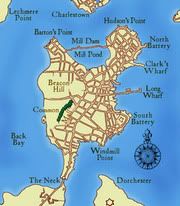
Penned up inside the town of Boston after the retreat from Concord, the British under General Gage and the newly arrived Generals Howe, Clinton, and Burgoyne planned to make their position more secure by seizing the heights of Charlestown and Dorchester, and then converging on the main rebel force at Cambridge. The New England rebels pre-empted this plan by secretly fortifying Breed's Hill in Charlestown on the night of June 16-17.

The next day, with frigates and shore batteries bombarding the rebel positions and burning Charlestown, General Howe landed on the Charlestown shore with an eventual force of 2,500 redcoats. The New England rebels under Massachusetts' Colonel William Prescott, New Hampshire's Colonel John Stark, and Connecticut's General Israel Putnam were not impressed and held their ground atop Breed's Hill.
The British plan was not to launch a frontal assault, but to have the fast-moving light infantry companies strike quickly along the Mystic River beach, get up behind the rebel fortifications, and attack from the rear, while the rest of the assault force kept them pinned in front. Efforts to land troops in the rear of the rebel works were impossible because of the tide.
By the time the troops were landed, and General Howe had a chance to see how things looked on the ground, the rebels had fortified the beach that the light infantry was to use. The emphasis of the first attack was still trying to get a column of light infantry to hammer a way through the hastily-constructed stone wall on the beach. But the cost proved too high, and the light infantry recoiled after company after company had been decimated.

Two frontal assaults were driven back with huge British losses. Howe's third assault only succeeded when the rebel defenders ran out of ammunition. Fierce hand-to-hand fighting erupted in the redoubt as the Massachusetts men there withdrew. Doctor Joseph Warren, the leading figure of the Massachusetts rebel government was killed at the end of the battle as he and other volunteers tried to cover the retreat.

Howe, who had lost 1,054 killed and wounded, including 10 of his 12 aides, found his troops too decimated and exhausted to pursue. The plan to sweep from Charlestown on to Cambridge and Roxbury was abandoned. The rebels lost some 300 killed and prisoners and a few hundred wounded. Recriminations followed in the Rebel camp, with courts martial the order of the day. Not all the New England troops or leaders had behaved as well in the fighting as had Prescott, Putnam, and Stark. Troops atop Bunker Hill behind the battle scene had refused Putnam's orders to join the battle, and had cowered from the cannon fire in droves. Other troops sent to reinforce the rebel positions refused to cross Charlestown Neck, the narrow strip of land connecting Charlestown to the mainland of Massachusetts, as British naval cannons swept the Neck.

Howe, who succeeded Gage in the supreme command later in the year, was transformed by the bloody experience. He would win a knighthood and much praise for his handling of the army, driving Washington from position after position in New York, New Jersey, and Pennsylvania. Never again, even when his subordinates told him that all he need do was press an attack on a dispirited American force crouching behind makeshift entrenchments to finish Washington off, would he commit his forces to a direct frontal attack. He would use flanking movements, coups de main, amphibious landings. But never again would he hurl his army against defended positions. Because of that, the Continental Army would live to fight another day, again and again.
Today, the battlefield, except for the block-sized area where the monument is located- the site of the redoubt- is covered over by highways and row houses. Authentic re-enactments of the battle on the site are impossible because of this, and because of National Park Service regulations.

But a perversion of the spirit of Bunker Hill is perhaps the battle's most enduring living legacy. Many state workers and city workers in Suffolk County have long had the day off as a result of union contracts. So Bunker Hill Day is primarily comemmorated in Massachusetts as a Hack High Holy Day. It is most unfortunate that this is the most we do to remember the bravery of those Yankee rebels and the intrepid redcoats, whose descendants are now our staunchest allies.
The Massachusetts Historical Society has an exhibit on the battle on-line.
Penned up inside the town of Boston after the retreat from Concord, the British under General Gage and the newly arrived Generals Howe, Clinton, and Burgoyne planned to make their position more secure by seizing the heights of Charlestown and Dorchester, and then converging on the main rebel force at Cambridge. The New England rebels pre-empted this plan by secretly fortifying Breed's Hill in Charlestown on the night of June 16-17.
The next day, with frigates and shore batteries bombarding the rebel positions and burning Charlestown, General Howe landed on the Charlestown shore with an eventual force of 2,500 redcoats. The New England rebels under Massachusetts' Colonel William Prescott, New Hampshire's Colonel John Stark, and Connecticut's General Israel Putnam were not impressed and held their ground atop Breed's Hill.
The British plan was not to launch a frontal assault, but to have the fast-moving light infantry companies strike quickly along the Mystic River beach, get up behind the rebel fortifications, and attack from the rear, while the rest of the assault force kept them pinned in front. Efforts to land troops in the rear of the rebel works were impossible because of the tide.
By the time the troops were landed, and General Howe had a chance to see how things looked on the ground, the rebels had fortified the beach that the light infantry was to use. The emphasis of the first attack was still trying to get a column of light infantry to hammer a way through the hastily-constructed stone wall on the beach. But the cost proved too high, and the light infantry recoiled after company after company had been decimated.
Two frontal assaults were driven back with huge British losses. Howe's third assault only succeeded when the rebel defenders ran out of ammunition. Fierce hand-to-hand fighting erupted in the redoubt as the Massachusetts men there withdrew. Doctor Joseph Warren, the leading figure of the Massachusetts rebel government was killed at the end of the battle as he and other volunteers tried to cover the retreat.

Howe, who had lost 1,054 killed and wounded, including 10 of his 12 aides, found his troops too decimated and exhausted to pursue. The plan to sweep from Charlestown on to Cambridge and Roxbury was abandoned. The rebels lost some 300 killed and prisoners and a few hundred wounded. Recriminations followed in the Rebel camp, with courts martial the order of the day. Not all the New England troops or leaders had behaved as well in the fighting as had Prescott, Putnam, and Stark. Troops atop Bunker Hill behind the battle scene had refused Putnam's orders to join the battle, and had cowered from the cannon fire in droves. Other troops sent to reinforce the rebel positions refused to cross Charlestown Neck, the narrow strip of land connecting Charlestown to the mainland of Massachusetts, as British naval cannons swept the Neck.
Howe, who succeeded Gage in the supreme command later in the year, was transformed by the bloody experience. He would win a knighthood and much praise for his handling of the army, driving Washington from position after position in New York, New Jersey, and Pennsylvania. Never again, even when his subordinates told him that all he need do was press an attack on a dispirited American force crouching behind makeshift entrenchments to finish Washington off, would he commit his forces to a direct frontal attack. He would use flanking movements, coups de main, amphibious landings. But never again would he hurl his army against defended positions. Because of that, the Continental Army would live to fight another day, again and again.
Today, the battlefield, except for the block-sized area where the monument is located- the site of the redoubt- is covered over by highways and row houses. Authentic re-enactments of the battle on the site are impossible because of this, and because of National Park Service regulations.

But a perversion of the spirit of Bunker Hill is perhaps the battle's most enduring living legacy. Many state workers and city workers in Suffolk County have long had the day off as a result of union contracts. So Bunker Hill Day is primarily comemmorated in Massachusetts as a Hack High Holy Day. It is most unfortunate that this is the most we do to remember the bravery of those Yankee rebels and the intrepid redcoats, whose descendants are now our staunchest allies.
The Massachusetts Historical Society has an exhibit on the battle on-line.
Labels: American Revolution
Saturday, April 19, 2008
The Places Of April 19, 1775
In years past, I have featured numerous reenactment images of the fighting on April 19, 1775. This year, I want to look more closely at the places associated with the beginning of the American Revolutionary War.

Let's start in Boston, at the Old North Church. This is the church steeple in which Robert Newman hung the two lanterns to tell the Whig leaders in Charlestown that a redcoat force was about to march by land, with its most probable target being Concord. No, the lanterns did not tell Paul Revere about it. He had arranged for the lanterns as a back-up in case he was captured while crossing the ferryway to Charlestown. Revere got across and the lantern scheme proved unnecessary.

A. Lassell Ripley's painting, orignally executed as part of a series for the Paul Revere Life Insurance Company, showing Revere crossing the Charles in a rowboat, virtually under the guns of the 68-gun HMS Somerset.

The Foot of the Common. Now the corner of Boylston Street and Charles Street, between L.J. Peretti's Smokeshop and the grave yard. This is where Lt. Colonel Francis Smith of the 10th Regiment of Foot (being the senior Lt. Col. in the Boston Garrison) and Major John Pitcairn, commander of the Marine Battalion (and the senior Major of the Boston Garrison) assembled their expedition to Concord on the night of April 18th.

Lechmere Point in East Cambridge. On this marshy shore (now filled in and the site of the Cambridgeside Galleria mall, and formerly the site of the original store of the now defunct Lechmere home appliance store chain) the 11 companies of grenadiers (of the 4th, 5th, 10th, 18th, 23rd, 38th, 43rd, 47th, Marines, 52nd, and 59th Regiments) and 10 companies of light infantry (of the 4th, 5th 10th, 23rd, 38th, 43rd, 47th, Marines, 52nd, and 59th Regiments), landed after being rowed by the navy's boat crews. The ground for a good half mile inland in this remote part of Cambridge was marshy and boggy, not unlike the ground seen around Revere/Saugus/Lynn and further up the North Shore at Ipswich. The troops had to make the best of it.

The Hancock Clark House, parsonage of Rev. Jonas Clark, the cousin of John Hancock, and currently host to John Hancock and Samuel Adams, as they attended meetings of the Provincial Congress in Concord. It was here that Revere, and then William Dawes warned Hancock and Adams of the approach of Smith's expedition (as its secondary aim, no doubt covered in verbal orders) was the arrest of these two leaders, and any others that were caught by surprise by the troops.

A. Lassell Ripley painting of Revere giving the warning to Hancock and Adams in the great room of the parsonage. Hancock wanted to shoulder a musket and join the Lexington Company on the Green. Adams, Revere, Dawes, and Clark eventually prevailed upon him to seek safety in Burlington, since his capture was part of the objective of the troops' mission.

Nelson Road, where Revere, Dawes, and Concord's Dr. Samuel Prescott were warning the inhabitants of the approach of the troops, as they went on to Concord. Concord was not just the meeting place of the Provincial Congress, as sort of rebel rump colonial legislature, meeting in defiance of royal bans on such meetings. It was also a principle arms and accoutrements magazine for the Rebel Army, which had been authorized by the Provincial Congress. Supplies of muskets, cannon, gunpowder, tents, musket balls, leather for belting and harnesses, mess kits, and all sorts of supplies for an army were being stored in Concord. An advance British patrol of officers had ridden by earlier (with the intention of stopping couriers from alerting Concord of the troops' approach), and had a violent encounter with volatile Josiah Nelson. Nelson had apparently showered the officers with some ill-chosen billingsgate, and been rewarded with a whack to the side of his head by the flat of an officer's sword.

The Paul Revere Capture Site. No, Paul Revere, Longfellow notwithstanding, never made it to Concord that night. A patrol of British officers, led by Major Edward Mitchell of the 5th Regiment, surprised and captured Revere, Dawes, and Prescott. Dawes was able, by a ruse, to get away from the officers, heading back in the direction of Boston. Prescott also escaped, and returned to the road closer to Concord, and actually brought word of Smith's mission to Concord. Revere was most unlucky, and his attempt to escape was prevented. He remained a prisoner for about an hour or so, until the patrol, growing edgy about the sounds of military activity around Lexington Common, let him go, on foot. Revere went back to the Hancock Clark House, to find Adams and Honcock still arguing about whether to go to Burlington or stay put. His story was the final straw in the case for staying put, and Hancock relucantly agreed to leave with Adams.

The Captain William Smith House. William Smith was not just the captain of a newly-raised Lincoln minutmen company, he was also the younger brother of Abigail Adams. It was here, about a half mile up the road closer to Concord, that Dr. Prescott regained the road.
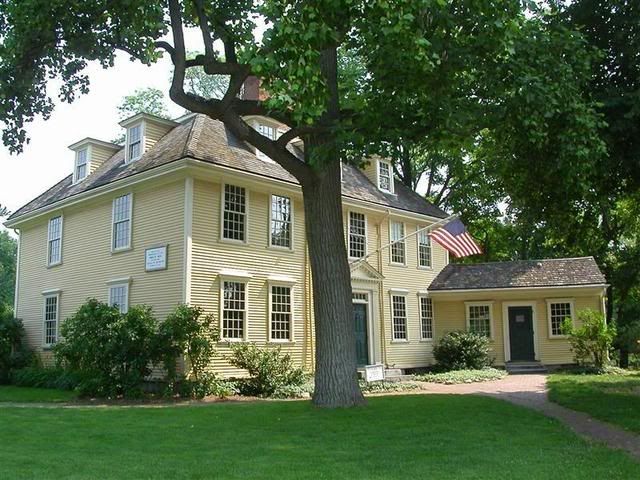
Lexington's Buckman Tavern. This tavern, located just across from the Lexington town common, became the gathering place for Lexington's single large company (around 144 men) of militia. They were not minutemen, as the minutemen had a seperate county-organized regimental structure, and Lexington was slow in complying with the request of the Provincial Congress to create a minute company of picked men from its militia. John Hancock had left a trunk of important documents here, and Revere and Hancock's private secretary were tasked with retrieving this trunk, just as the first light bobs appeared up the road in what is now Lexington Center.

The Lexington belfry, detached from the Meetinghouse and standing next to it, though it has now been relocated to a nearby hill. The bell ringing its alarm and the gathering of the Lexington milita to it was part of what made Major Mitchell release a man who he knew was an important prisoner, Revere.

Lexington Common. Imagine no statue, and many fewer stately trees. No flagpole. No benches. The greensward extending into the lanes of both Routes 4 & 225 on our right, and Massachusetts Avenue, on our left. Imagine a box-like meetinghouse where the statue is, the belfry standing behind it. And, of course, no boulder marking the spot where the Lexington militia took up its position. The Hancock Clark House is just a quarter mile up on the right.
Colonel Smith, while still in Menotomy, present-day Arlington, had detached 6 companies of light infantry under Major Pitcairn (10th, 4th, 5th, 23rd, Marines, 52nd) to march ahead of his grenadiers, and seize the two bridges over the Concord River. These met with Major Mitchell and his patrol, and captured various scouts and couriers on the road that early morning. About sunrise, the light infantry came into view, just behind a scout sent out by Captain Parker. Parker's men hastily reassembled on the common.
Pitcairn galloped ahead of his men, and ordered the rebels to lay down their arms and disperse. They did not do that, and the light infantry came up at a run, and began deploying to surround the rebels. A shot rang out. The shot was followed by a volley from the 10th's light company, and then by the 4th's. Then a general melee ensued, as each of the 6 companies broke ranks and surged forward, firing at anything that moved, and bayonetting anything that didn't. The light bobs ignored Pitcairn's repeated orders to reform. Smith came up, and had a drummer beat "To Arms." That brought the men back to a sense of their duty. They reformed on the common, while the grenadiers kept to the road. Smith held a council of war with the officers, while the serjeants raged at the men. The officers were of the opinion that the bloodshed justified returning empty-handed to Boston. But Smith had his orders, and resolved to continue on to Concord to search for supplies. Eight Lexington militia were dead, and more wounded. One light bob of the 10th had been slightly wounded by the return fire of the militia.

Boulder marking where the militia made their stand. Engraved on it is what Parker allegedly said.

The Jonathan Harrington House, just behind the common. Harrington was a private in the militia company, and received a mortal wound from a musket ball. He dragged himself to his front door, and died in his wife's arms.

The Burial Ground, where the dead militiamen were given a hasty burial. They were later reburied at the sight of the obelisk-style monument erected on the common, between the site of the belfry and that of the schoolhouse.

Concord's Wright's Tavern, in the center of Concord. It was rebel headquarters in Concord, until the approach of the troops forced them back, across the North Bridge, to Punkatasset Hill.

The Old North Bridge. This bridge spanned the Concord River, and was one of two that did so, connecting central Concord with the rest. Three companies of light infantry (4th, 10th, 47th Regiments), about 100 men, held the bridge, under the command of Captain Walter Laurie of the 47th (the 4th's captain, Nesbitt Balfour, was commanding a 100 man detachment in Marshfield on long-term assignment there to protect local loyalists, while the 10th's captain, Lawrence Parsons, was on the other side of the river with 4 companies searching the Barrett Farm). When smoke from burning supplies was seen by the 400 militia and minutemen who had assembled just west of the Buttrick Farm, thinking the town was being put to the torch, the rebels resolved to march to the bridge, and dislodge the redcoats, who they outnumbered 4-1.
Acton's minutemen company commanded by Issac Davis, a blacksmith who had fashioned bayonets for all his men, led the way. The light infantry had not prepared a proper defence, and did not know what to do. They fired on the rebels, and the rebels returned fire. The troops were not prepared properly for the street firing tactic Laurie hoped to use to defend the bridge, and bunched up at the foot of the bridge under heavy fire, until they just turned around and ran back to Concord Center. Smith belatedly came up with two companies of grenadiers as reinforcements. Parsons somehow got past the rebels, and returned safely and without incident to Concord.

The Buttrick Farm, just above the North Bridge. Major John Buttrick was the second in command of a new-raised regiment of minutemen, part of which came from Concord.

The Old Manse, parsonage of Reverend William Emerson, grandfather of Ralph Waldo Emerson. A crowd of frightened women and children was seeking comfort from their minister here at the parsonage as the rebel troops, and then the redcoats, passed them. The Manse is just adjacent to the side of the Bridge the British ended up on. In the 19th century, Emerson lived there, and for a time rented it to Hawthorne.

The Barrett Farm. Colonel James Barrett has an important Concordian. He was an influential member of the Provincial Congress. He was also commander of a regiment of militia with some of its companies based in Concord. And his farm was a major rebel supply depot. It is located about 2 miles west of the Old North Bridge. Muskets were literally plowed into the furrows of the fields at the approach of the redcoats, and cannons had just been secreted off to Worcester. It was searched, with little result, by four companies of light infantry (5th, 23rd, 38th, and 52nd) commanded by Captain Lawrence Parsons of the 10th Regiment. The house is currently in a poor state of preservation, because it is so far from the main area connected with the battle. But efforts are now underway to preserve it.

Meriam's Corner. On the road back to Boston, the Meriam farmhouse is about 50 yards north of the road. But a road from Woburn and Reading intersects the Boston road here. It was here that the rebel militia,both veterans of the fight at the bridge, and fresh troops rom Reading, Woburn, and Chelmsford and redcoats collided in the first of a series of engagements that would go on until the grenadiers and light infantry met up with Earl Percy's First Brigade, sent in relief, in Lexington. The grenadiers kept to the road, while the light infantry formed security parties on the flanks, probably about 20-30 yards off the road. It was these light infantry that began the firing on rebel militia dangerously close to the column. The firing from both sides of the road now became general. At Hardy's Hill the numerous companies of Framingham and Sudbury joined the fight, about a half mile down the road and on its southern side.

The Bloody Angles. Actually, the name for this part of the Battle Road is borrowed from a Civil War battlefield. The road to Boston makes 2 90 degree angles here, first to the left, then, further up, to the right. The rebels made good use of cover here to sting the redcoats with musket fire from relatively close range. Most of the shooting was from over 100 yards away, which led to the dismal calculation that only about 1 of every 300 balls fired by the rebels did any damage. But here, the rebels could get in close. But the problem for them was that, getting in close allowed them to be targets for the flanking parties of light infantry trying to protect the column. Casualties on both sides began to climb, but with the troops on the road, or exposed as flanking detachments getting the worst of it. Note that the rebels fired not from behind the stone wall immediately beside the road. That would have been suicidal. They fired from the tree line or wall next back, usually from over 100 yards range.

Captain Parker's company of Lexington militia ambushed the redcoats from this pine-filled elevation. It was an excellently chosen location, and just within Lexington's border with Lincoln. Several officers were wounded here, including Col. Smith, in the leg. it was a significant act of leadership for Parker to get his shattered command back together, and get it back in the battle.
The column of redcoats was now in some disorder, and a bluff overlooking the north side of the road as it curves up to Fiske Hill was a vitally important position. If the rebels held it, they could pour fire directly into the column below. Major Pitcairn ordered his own companies of Marine light infantry and grenadiers to hold this position (they were over twice the size of the regular army companies, which on paper had only 38 privates and corporals, 2 serjeants, and 3 officers each). There was heavy fighting, but Pitcairn's men held the bluff until the rearguard got by. Then the rebels gained possession.
Fiske Hill Fresh rebel companies from Cambridge joined the battle here, and the fighting was severe. Pitcairn's horse bolted, and was captured by the rebels, along with his fine Scottish pistols in the saddle holsters. The column was now temporarily leaderless with Smith among the wounded, and Pitcairn temporarily out of action. The disorder increased. The men at this point were almost out of ammunition, and were now running away rather than fighting.

Hayward's Well Adjacent to the Ebenezer Fiske House (which no longer stands, but its foundation line is maked out by stones). Here, very close to the road, probably as the rear guard had just passed, and a few redcoated stragglers tried to keep up, James Hayward of Acton and an unnamed redcoat shot each other, and both died. The column now descended into a valley between Fiske Hill and Concord Hill, through which now runs Route 128. When it topped Concord Hill, the company officers got to the front, and forced the men to reform, under a heavy rebel fire. But on the other side of Lexington, all could now see the 32 companies of Earl Percy's First Brigade (the 8 battalion companies of the 4th, 23rd, 47th, and Marines) drawn up, with two Royal Artillery six-pounder cannon.
Rebel pressure on the flanks ceased after they got a taste of Percy's cannon. Smith's shattered command limped across Lexington common and rested under the protection of Percy's men for about a half hour. It was now around 3pm, and the column had a long way to go to get back to Boston, while more rebel companies poured in from Middlesex, Essex, Norfolk, and Worcester counties.

The Monroe Tavern This building became the de facto headquarters for Lord Percy as his brigade protected the remnants of Smith's command. Smith's forces reformed and refreshed themselves. The wounded were treated either in the tavern or on its grounds by the few medical personnel available (essentially a surgeon's mate of the 43rd Regiment named Simms). The 23rd Foot (Royal Welch Fusiliers) now replaced Captain Harris's pressed grenadier company of the 5th as the rear guard. After burning some of the surrounding houses lest they become nests of rebel snipers, Percy began his march back to Boston.

The Jason Russell House Jason Russell was a man in his late 50s, partially lame, who chose to defend his farmhouse. He was joined by numerous militia and minutemen from Danvers, Lynn, and Needham. But Percy's flanking parties, fresh from heavy fighting at the Foot of the Rocks, modern Arlington Heights, were too good, and 12 militia were killed around Russell's house, including Russell himself.

Samuel Whittemore was an 79 year old man exempt from militia service. Nevertheless, this Indian wars veteran took his musket, his sword, and a brace of pistols with him, and decided to meet the column on his own. He killed or wounded several troops, before he was shot and bayoneted 13 times, and beaten with musket butts. He was left for dead, and the rebel surgeons refused to treat him as a lost cause, but he recovered and lived 18 years more.
Percy forced his way through a rebel trap, which was an effort to force his column to march over the "Great Bridge" over the Charles (which was the way Percy had come out from Boston) instead of the shorter route via Charlestown. The rebels had prepared an elaborae ambush at the Great Bridge, having taken up the planks again, and used them as a barricade on the opposite bank, with lots of rebel militia lining the banks and on the flanks of the road. Percy unlimered his guns again and blasted his way through the ambush, and took the shorter route to Charlestown. That brought his men under the protection of the guns of the navy, and because of the shape of the Charlestown Peninsula and its narrow neck, the rebels could not follow. His men rested atop Bunker Hill and all over Charlestown, while the wounded were ferried over. Fresh troops from the now thin Boston garrison secured Charlestown Neck. The next morning, Percy's men were ferried back to Boston. Two months later, the redcoats would have to fight even harder and suffer even more casualties to recapture Bunker Hill.
Let's start in Boston, at the Old North Church. This is the church steeple in which Robert Newman hung the two lanterns to tell the Whig leaders in Charlestown that a redcoat force was about to march by land, with its most probable target being Concord. No, the lanterns did not tell Paul Revere about it. He had arranged for the lanterns as a back-up in case he was captured while crossing the ferryway to Charlestown. Revere got across and the lantern scheme proved unnecessary.
A. Lassell Ripley's painting, orignally executed as part of a series for the Paul Revere Life Insurance Company, showing Revere crossing the Charles in a rowboat, virtually under the guns of the 68-gun HMS Somerset.
The Foot of the Common. Now the corner of Boylston Street and Charles Street, between L.J. Peretti's Smokeshop and the grave yard. This is where Lt. Colonel Francis Smith of the 10th Regiment of Foot (being the senior Lt. Col. in the Boston Garrison) and Major John Pitcairn, commander of the Marine Battalion (and the senior Major of the Boston Garrison) assembled their expedition to Concord on the night of April 18th.
Lechmere Point in East Cambridge. On this marshy shore (now filled in and the site of the Cambridgeside Galleria mall, and formerly the site of the original store of the now defunct Lechmere home appliance store chain) the 11 companies of grenadiers (of the 4th, 5th, 10th, 18th, 23rd, 38th, 43rd, 47th, Marines, 52nd, and 59th Regiments) and 10 companies of light infantry (of the 4th, 5th 10th, 23rd, 38th, 43rd, 47th, Marines, 52nd, and 59th Regiments), landed after being rowed by the navy's boat crews. The ground for a good half mile inland in this remote part of Cambridge was marshy and boggy, not unlike the ground seen around Revere/Saugus/Lynn and further up the North Shore at Ipswich. The troops had to make the best of it.
The Hancock Clark House, parsonage of Rev. Jonas Clark, the cousin of John Hancock, and currently host to John Hancock and Samuel Adams, as they attended meetings of the Provincial Congress in Concord. It was here that Revere, and then William Dawes warned Hancock and Adams of the approach of Smith's expedition (as its secondary aim, no doubt covered in verbal orders) was the arrest of these two leaders, and any others that were caught by surprise by the troops.
A. Lassell Ripley painting of Revere giving the warning to Hancock and Adams in the great room of the parsonage. Hancock wanted to shoulder a musket and join the Lexington Company on the Green. Adams, Revere, Dawes, and Clark eventually prevailed upon him to seek safety in Burlington, since his capture was part of the objective of the troops' mission.
Nelson Road, where Revere, Dawes, and Concord's Dr. Samuel Prescott were warning the inhabitants of the approach of the troops, as they went on to Concord. Concord was not just the meeting place of the Provincial Congress, as sort of rebel rump colonial legislature, meeting in defiance of royal bans on such meetings. It was also a principle arms and accoutrements magazine for the Rebel Army, which had been authorized by the Provincial Congress. Supplies of muskets, cannon, gunpowder, tents, musket balls, leather for belting and harnesses, mess kits, and all sorts of supplies for an army were being stored in Concord. An advance British patrol of officers had ridden by earlier (with the intention of stopping couriers from alerting Concord of the troops' approach), and had a violent encounter with volatile Josiah Nelson. Nelson had apparently showered the officers with some ill-chosen billingsgate, and been rewarded with a whack to the side of his head by the flat of an officer's sword.
The Paul Revere Capture Site. No, Paul Revere, Longfellow notwithstanding, never made it to Concord that night. A patrol of British officers, led by Major Edward Mitchell of the 5th Regiment, surprised and captured Revere, Dawes, and Prescott. Dawes was able, by a ruse, to get away from the officers, heading back in the direction of Boston. Prescott also escaped, and returned to the road closer to Concord, and actually brought word of Smith's mission to Concord. Revere was most unlucky, and his attempt to escape was prevented. He remained a prisoner for about an hour or so, until the patrol, growing edgy about the sounds of military activity around Lexington Common, let him go, on foot. Revere went back to the Hancock Clark House, to find Adams and Honcock still arguing about whether to go to Burlington or stay put. His story was the final straw in the case for staying put, and Hancock relucantly agreed to leave with Adams.
The Captain William Smith House. William Smith was not just the captain of a newly-raised Lincoln minutmen company, he was also the younger brother of Abigail Adams. It was here, about a half mile up the road closer to Concord, that Dr. Prescott regained the road.
Lexington's Buckman Tavern. This tavern, located just across from the Lexington town common, became the gathering place for Lexington's single large company (around 144 men) of militia. They were not minutemen, as the minutemen had a seperate county-organized regimental structure, and Lexington was slow in complying with the request of the Provincial Congress to create a minute company of picked men from its militia. John Hancock had left a trunk of important documents here, and Revere and Hancock's private secretary were tasked with retrieving this trunk, just as the first light bobs appeared up the road in what is now Lexington Center.
The Lexington belfry, detached from the Meetinghouse and standing next to it, though it has now been relocated to a nearby hill. The bell ringing its alarm and the gathering of the Lexington milita to it was part of what made Major Mitchell release a man who he knew was an important prisoner, Revere.
Lexington Common. Imagine no statue, and many fewer stately trees. No flagpole. No benches. The greensward extending into the lanes of both Routes 4 & 225 on our right, and Massachusetts Avenue, on our left. Imagine a box-like meetinghouse where the statue is, the belfry standing behind it. And, of course, no boulder marking the spot where the Lexington militia took up its position. The Hancock Clark House is just a quarter mile up on the right.
Colonel Smith, while still in Menotomy, present-day Arlington, had detached 6 companies of light infantry under Major Pitcairn (10th, 4th, 5th, 23rd, Marines, 52nd) to march ahead of his grenadiers, and seize the two bridges over the Concord River. These met with Major Mitchell and his patrol, and captured various scouts and couriers on the road that early morning. About sunrise, the light infantry came into view, just behind a scout sent out by Captain Parker. Parker's men hastily reassembled on the common.
Pitcairn galloped ahead of his men, and ordered the rebels to lay down their arms and disperse. They did not do that, and the light infantry came up at a run, and began deploying to surround the rebels. A shot rang out. The shot was followed by a volley from the 10th's light company, and then by the 4th's. Then a general melee ensued, as each of the 6 companies broke ranks and surged forward, firing at anything that moved, and bayonetting anything that didn't. The light bobs ignored Pitcairn's repeated orders to reform. Smith came up, and had a drummer beat "To Arms." That brought the men back to a sense of their duty. They reformed on the common, while the grenadiers kept to the road. Smith held a council of war with the officers, while the serjeants raged at the men. The officers were of the opinion that the bloodshed justified returning empty-handed to Boston. But Smith had his orders, and resolved to continue on to Concord to search for supplies. Eight Lexington militia were dead, and more wounded. One light bob of the 10th had been slightly wounded by the return fire of the militia.
Boulder marking where the militia made their stand. Engraved on it is what Parker allegedly said.
The Jonathan Harrington House, just behind the common. Harrington was a private in the militia company, and received a mortal wound from a musket ball. He dragged himself to his front door, and died in his wife's arms.
The Burial Ground, where the dead militiamen were given a hasty burial. They were later reburied at the sight of the obelisk-style monument erected on the common, between the site of the belfry and that of the schoolhouse.
Concord's Wright's Tavern, in the center of Concord. It was rebel headquarters in Concord, until the approach of the troops forced them back, across the North Bridge, to Punkatasset Hill.
The Old North Bridge. This bridge spanned the Concord River, and was one of two that did so, connecting central Concord with the rest. Three companies of light infantry (4th, 10th, 47th Regiments), about 100 men, held the bridge, under the command of Captain Walter Laurie of the 47th (the 4th's captain, Nesbitt Balfour, was commanding a 100 man detachment in Marshfield on long-term assignment there to protect local loyalists, while the 10th's captain, Lawrence Parsons, was on the other side of the river with 4 companies searching the Barrett Farm). When smoke from burning supplies was seen by the 400 militia and minutemen who had assembled just west of the Buttrick Farm, thinking the town was being put to the torch, the rebels resolved to march to the bridge, and dislodge the redcoats, who they outnumbered 4-1.
Acton's minutemen company commanded by Issac Davis, a blacksmith who had fashioned bayonets for all his men, led the way. The light infantry had not prepared a proper defence, and did not know what to do. They fired on the rebels, and the rebels returned fire. The troops were not prepared properly for the street firing tactic Laurie hoped to use to defend the bridge, and bunched up at the foot of the bridge under heavy fire, until they just turned around and ran back to Concord Center. Smith belatedly came up with two companies of grenadiers as reinforcements. Parsons somehow got past the rebels, and returned safely and without incident to Concord.
The Buttrick Farm, just above the North Bridge. Major John Buttrick was the second in command of a new-raised regiment of minutemen, part of which came from Concord.
The Old Manse, parsonage of Reverend William Emerson, grandfather of Ralph Waldo Emerson. A crowd of frightened women and children was seeking comfort from their minister here at the parsonage as the rebel troops, and then the redcoats, passed them. The Manse is just adjacent to the side of the Bridge the British ended up on. In the 19th century, Emerson lived there, and for a time rented it to Hawthorne.
The Barrett Farm. Colonel James Barrett has an important Concordian. He was an influential member of the Provincial Congress. He was also commander of a regiment of militia with some of its companies based in Concord. And his farm was a major rebel supply depot. It is located about 2 miles west of the Old North Bridge. Muskets were literally plowed into the furrows of the fields at the approach of the redcoats, and cannons had just been secreted off to Worcester. It was searched, with little result, by four companies of light infantry (5th, 23rd, 38th, and 52nd) commanded by Captain Lawrence Parsons of the 10th Regiment. The house is currently in a poor state of preservation, because it is so far from the main area connected with the battle. But efforts are now underway to preserve it.
Meriam's Corner. On the road back to Boston, the Meriam farmhouse is about 50 yards north of the road. But a road from Woburn and Reading intersects the Boston road here. It was here that the rebel militia,both veterans of the fight at the bridge, and fresh troops rom Reading, Woburn, and Chelmsford and redcoats collided in the first of a series of engagements that would go on until the grenadiers and light infantry met up with Earl Percy's First Brigade, sent in relief, in Lexington. The grenadiers kept to the road, while the light infantry formed security parties on the flanks, probably about 20-30 yards off the road. It was these light infantry that began the firing on rebel militia dangerously close to the column. The firing from both sides of the road now became general. At Hardy's Hill the numerous companies of Framingham and Sudbury joined the fight, about a half mile down the road and on its southern side.
The Bloody Angles. Actually, the name for this part of the Battle Road is borrowed from a Civil War battlefield. The road to Boston makes 2 90 degree angles here, first to the left, then, further up, to the right. The rebels made good use of cover here to sting the redcoats with musket fire from relatively close range. Most of the shooting was from over 100 yards away, which led to the dismal calculation that only about 1 of every 300 balls fired by the rebels did any damage. But here, the rebels could get in close. But the problem for them was that, getting in close allowed them to be targets for the flanking parties of light infantry trying to protect the column. Casualties on both sides began to climb, but with the troops on the road, or exposed as flanking detachments getting the worst of it. Note that the rebels fired not from behind the stone wall immediately beside the road. That would have been suicidal. They fired from the tree line or wall next back, usually from over 100 yards range.
Captain Parker's company of Lexington militia ambushed the redcoats from this pine-filled elevation. It was an excellently chosen location, and just within Lexington's border with Lincoln. Several officers were wounded here, including Col. Smith, in the leg. it was a significant act of leadership for Parker to get his shattered command back together, and get it back in the battle.
The column of redcoats was now in some disorder, and a bluff overlooking the north side of the road as it curves up to Fiske Hill was a vitally important position. If the rebels held it, they could pour fire directly into the column below. Major Pitcairn ordered his own companies of Marine light infantry and grenadiers to hold this position (they were over twice the size of the regular army companies, which on paper had only 38 privates and corporals, 2 serjeants, and 3 officers each). There was heavy fighting, but Pitcairn's men held the bluff until the rearguard got by. Then the rebels gained possession.
Fiske Hill Fresh rebel companies from Cambridge joined the battle here, and the fighting was severe. Pitcairn's horse bolted, and was captured by the rebels, along with his fine Scottish pistols in the saddle holsters. The column was now temporarily leaderless with Smith among the wounded, and Pitcairn temporarily out of action. The disorder increased. The men at this point were almost out of ammunition, and were now running away rather than fighting.
Hayward's Well Adjacent to the Ebenezer Fiske House (which no longer stands, but its foundation line is maked out by stones). Here, very close to the road, probably as the rear guard had just passed, and a few redcoated stragglers tried to keep up, James Hayward of Acton and an unnamed redcoat shot each other, and both died. The column now descended into a valley between Fiske Hill and Concord Hill, through which now runs Route 128. When it topped Concord Hill, the company officers got to the front, and forced the men to reform, under a heavy rebel fire. But on the other side of Lexington, all could now see the 32 companies of Earl Percy's First Brigade (the 8 battalion companies of the 4th, 23rd, 47th, and Marines) drawn up, with two Royal Artillery six-pounder cannon.
Rebel pressure on the flanks ceased after they got a taste of Percy's cannon. Smith's shattered command limped across Lexington common and rested under the protection of Percy's men for about a half hour. It was now around 3pm, and the column had a long way to go to get back to Boston, while more rebel companies poured in from Middlesex, Essex, Norfolk, and Worcester counties.
The Monroe Tavern This building became the de facto headquarters for Lord Percy as his brigade protected the remnants of Smith's command. Smith's forces reformed and refreshed themselves. The wounded were treated either in the tavern or on its grounds by the few medical personnel available (essentially a surgeon's mate of the 43rd Regiment named Simms). The 23rd Foot (Royal Welch Fusiliers) now replaced Captain Harris's pressed grenadier company of the 5th as the rear guard. After burning some of the surrounding houses lest they become nests of rebel snipers, Percy began his march back to Boston.
The Jason Russell House Jason Russell was a man in his late 50s, partially lame, who chose to defend his farmhouse. He was joined by numerous militia and minutemen from Danvers, Lynn, and Needham. But Percy's flanking parties, fresh from heavy fighting at the Foot of the Rocks, modern Arlington Heights, were too good, and 12 militia were killed around Russell's house, including Russell himself.
Samuel Whittemore was an 79 year old man exempt from militia service. Nevertheless, this Indian wars veteran took his musket, his sword, and a brace of pistols with him, and decided to meet the column on his own. He killed or wounded several troops, before he was shot and bayoneted 13 times, and beaten with musket butts. He was left for dead, and the rebel surgeons refused to treat him as a lost cause, but he recovered and lived 18 years more.
Percy forced his way through a rebel trap, which was an effort to force his column to march over the "Great Bridge" over the Charles (which was the way Percy had come out from Boston) instead of the shorter route via Charlestown. The rebels had prepared an elaborae ambush at the Great Bridge, having taken up the planks again, and used them as a barricade on the opposite bank, with lots of rebel militia lining the banks and on the flanks of the road. Percy unlimered his guns again and blasted his way through the ambush, and took the shorter route to Charlestown. That brought his men under the protection of the guns of the navy, and because of the shape of the Charlestown Peninsula and its narrow neck, the rebels could not follow. His men rested atop Bunker Hill and all over Charlestown, while the wounded were ferried over. Fresh troops from the now thin Boston garrison secured Charlestown Neck. The next morning, Percy's men were ferried back to Boston. Two months later, the redcoats would have to fight even harder and suffer even more casualties to recapture Bunker Hill.
Labels: American Revolution
Tuesday, September 11, 2007
Anniversary of the Battle of Brandywine
230 years ago, General Sir William Howe out-maneuvered General George Washington again.

Not exactly what your history books told you the American Revolution looked like, is it?
Not exactly what your history books told you the American Revolution looked like, is it?
Labels: American Revolution