Monday, April 16, 2012
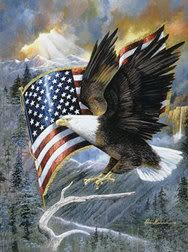
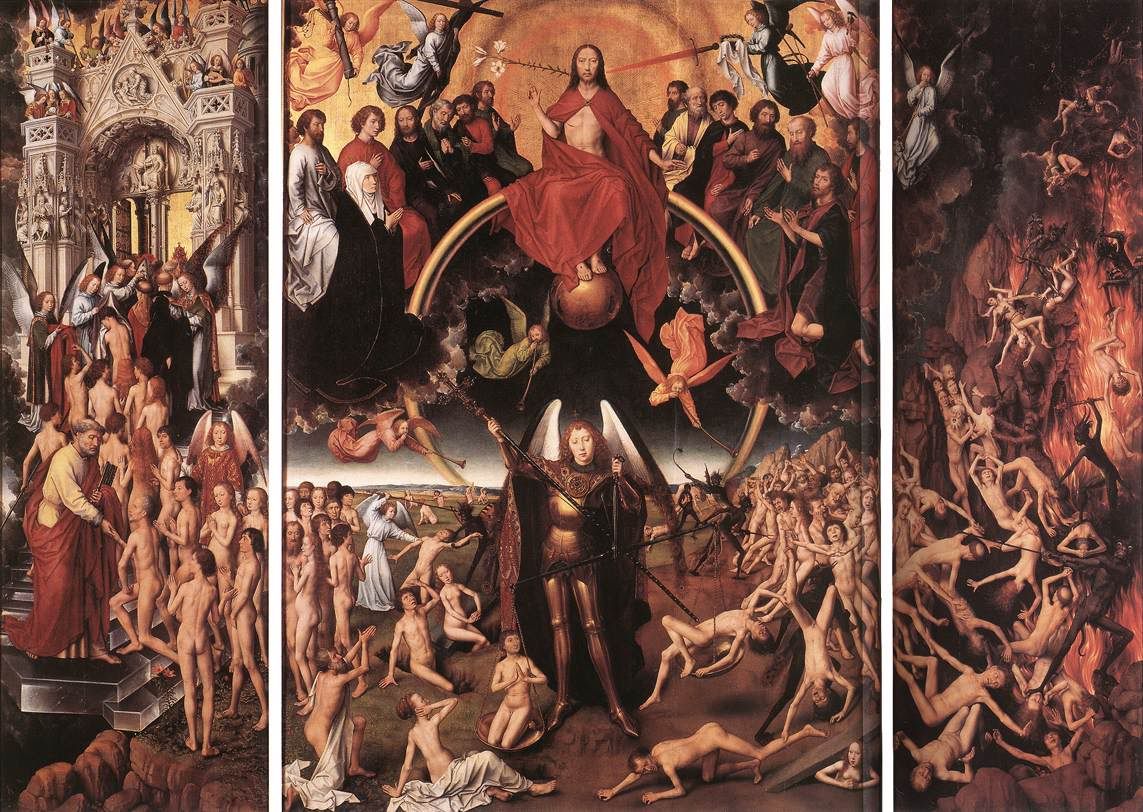
Patriots Day, 2012


Monday, February 13, 2012
Has the 2012 Republican Contest Reached A Tipping Point?
Mitt Romney seems to be the nominee-presumptive nobody really wants. Too liberal a record as Governor of Massachusetts, too liberal a family political pedigree, a perceived lack of there being any "there" there, and an exclusively privileged background in finance that is sure to be seized upon by the Administration and its pervasive allies in the media with unfathomable relish leave conservative Republicans in a quandry.
We are now down to 4 candidates, Romney, former Senator Rick Santorum, former House Speaker Newt Gingrich, and former Rep. Ron Paul. Gingrich's campaign seems to be on the point of imploding from a growing lack of money and a consistent lack of traction in the polls. National Review On Line is calling for him to step aside, and allow the conservative opposition to Romney to coalesce behind Senator Santorum, whose polling is surging, even in Michigan, where Romney's father was a liberal Republican governor in the 1960s, and can be considered a Romney home state.
Ron Paul is a libertarian first, and his views resemble orthodox conservatism by accidnent in a few instances.
Gingrich used to be a conservative hero, back in the day when he was trying to undermine moderate Republican leadership in the House, did so, and engineered the Republican takeover of the House in 1994 via the unfairly maligned Contract With America. Gingrich has plenty of charisma-potential, but it seems his energies are side-tracked and twisted by a desire to have the spotlight shining on him. He is a great debater, but perfectly willing to abandon any shred of principle to win an argument.
And that leaves Santorum as the only orthodox conservative in the race. He lacks charisma, but so does everybody but Gingrich. Santorum is steady and dependable. His views are shaped by immersion in the conservative movement over the last 20+ years, and his Catholic faith and values. His views are more-or-less just like those of Ronald Reagan, though he lacks Reagan's larger-than-life persona.
I hope that it is not reading too much into his victories last week to hope that his campaign is hitting its stride at the right time, when Republicans are dismayed at the prospect of being saddled with another Ford, Dole, McCain Republican nominee when what they need is a Reagan. Peaking at the right time is in part a matter of luck, and in part a matter of judgment.
Here is hoping that the talk of the inevitablity of Romney is stilled forever after he is upset by Santorum in the Michigan primary.
We are now down to 4 candidates, Romney, former Senator Rick Santorum, former House Speaker Newt Gingrich, and former Rep. Ron Paul. Gingrich's campaign seems to be on the point of imploding from a growing lack of money and a consistent lack of traction in the polls. National Review On Line is calling for him to step aside, and allow the conservative opposition to Romney to coalesce behind Senator Santorum, whose polling is surging, even in Michigan, where Romney's father was a liberal Republican governor in the 1960s, and can be considered a Romney home state.
Ron Paul is a libertarian first, and his views resemble orthodox conservatism by accidnent in a few instances.
Gingrich used to be a conservative hero, back in the day when he was trying to undermine moderate Republican leadership in the House, did so, and engineered the Republican takeover of the House in 1994 via the unfairly maligned Contract With America. Gingrich has plenty of charisma-potential, but it seems his energies are side-tracked and twisted by a desire to have the spotlight shining on him. He is a great debater, but perfectly willing to abandon any shred of principle to win an argument.
And that leaves Santorum as the only orthodox conservative in the race. He lacks charisma, but so does everybody but Gingrich. Santorum is steady and dependable. His views are shaped by immersion in the conservative movement over the last 20+ years, and his Catholic faith and values. His views are more-or-less just like those of Ronald Reagan, though he lacks Reagan's larger-than-life persona.
I hope that it is not reading too much into his victories last week to hope that his campaign is hitting its stride at the right time, when Republicans are dismayed at the prospect of being saddled with another Ford, Dole, McCain Republican nominee when what they need is a Reagan. Peaking at the right time is in part a matter of luck, and in part a matter of judgment.
Here is hoping that the talk of the inevitablity of Romney is stilled forever after he is upset by Santorum in the Michigan primary.
Labels: American Patriotism Is Not A Sin
Friday, November 11, 2011
Veterans' Day 2011
My tribute to those who have served.
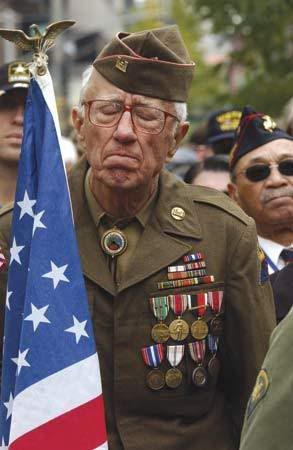
Thank you for your sacrifices!
Thank you for your sacrifices!
Labels: American Patriotism Is Not A Sin, Annual Cycles
Monday, July 04, 2011
July 4th, 1776

For those men who signed the Declaration of Independence on July 2nd, 1776, the odds did not look very good. Public opinion polls, if they existed, probably would have told them that only one-third of the population favored the course upon which they were about to embark. One-third was indifferent. One-third opposed independence. The men gathered from the thirteen colonies in Philadelphia, even without polling, probably had a sense that this was the case.
The army which would be the primary instrument of winning independence was scarcely disciplined, poorly uniformed, badly armed, and ill-supplied with food and ammunition. Pay was a promise (which, in fact, was mostly ignored 7 years later). Its generals had no experience commanding larger bodies of troops than a battalion.
True, there had been some victories. Boston had been rendered untenable for the enemy, and he had evacuated it. Fort Ticonderoga had fallen to a surprise attack, and supplied the heavy artillery that had led the British to evacuate Boston. Montreal had been captured, though that invasion force had been stopped at Quebec, and even now was building an anti-invasion fleet on Lake Champlain. The delegates in Philadelphia probably did not know it, but an enemy invasion of Charleston, SC had been averted a few days before.
But there had also been defeats. Despite inflicting heavy losses on the enemy, Bunker Hill had been captured. The attempt to capture Canada had failed miserably.
Most significant was what was coming. As the delegates debated independence, they knew that the British army that had left Boston was en route from Halifax, probably heading for New York. If their spies were accurate, that army would rendezvous with another escorted by an even larger fleet. Large numbers of British and German troops had driven the American Northern Army from Canada, and were poised to drive down Lake Champlain. These troops who would confront their own tattered, inexperienced army were the best Europe could field. British troops who had conquered an empire just 15 years before would be joined by excellent troops from Brunswick and Hesse Cassel, Frederick the Great's best allies. The enemy was supported by professional artillerists, and by a navy that was (despite peacetime decline and corruption) still, ship-for-ship, the best in the world. Thousands of their fellow countrymen would be happy to take up arms alongside the British army. To make matters worse, the Indian nations were ready to take up arms on behalf of the King, raising the prospect of burned farms, scalped settlers, and women and children abducted into captivity among the savages.
The men in Philadelphia must have found the prospect of declaring independence a daunting task. In the next three months, the most likely outcome was that the British army would take New York, flatten their own army, and then march on Philadelphia to hang them for treason. Their property would be taken from their families. At best they would become fugitives constantly on the run from British authorities.
But the best of them had a vision for the future, and strong reasons to feel the need to break with the past. The vision was that they would govern themselves, as they actually had for the most part, until the Imperial government decided to tap America for revenue to pay for keeping the peace with the Indians. John Winthrop's vision of a city set upon a hill remained a strong one, and merged with Locke's ideas about government, and newer ideas coming from Adam Smith about how an economy ought to be allowed to develop. A unified vision of a new nation which would serve as a beacon of liberty for all nations emerged, and was in the forefront of the minds of the men in Philadelphia. They had in this synthesis of ideas and in adapting to conditions on the American frontier, become a new nationality in need of a new nation.
And yet, despite all the obstacles, it was the vision that prevailed, and not the balance of forces. It is that vision that we celebrate today. John Adams, who did more than anyone to push the cause of independence through Congress, wrote to his wife that July 2, 1776 (the day the Declaration was approved):
"...Will be the most memorable epocha in the history of America. I am apt to believe that it will be celebrated by succeeding generations as the great anniversary festival. It ought to be commemorated as the Day of Deliverence by solemn acts of devotion to God Almighty. It ought to be solemnized with pomp and parade, with shows, games, sports, guns, bells, bonfires and illuminations from one end of this continent to the other from this time forward forever more."
May it always be so.

Labels: American Patriotism Is Not A Sin
Monday, April 18, 2011
Patriots' Day 2011


Labels: American Patriotism Is Not A Sin, American Revolution, New England Things, Once A Redcoat...
Monday, February 21, 2011
Revolutions In the Middle East
Hosni Mubarek has fallen from power in Egypt. The Tunisian government is no more. Right now, it appears that Colonel Qaddafi might have fled Tripoli, and that protesters are gradually taking control throughout Libya.
Americans are left pondering what this all means.
Are these revolutions of rising expectations, where the aim is more freedom and more prosperity for the peoples of these countries? Or are these Trojan Horses for the introduction of even more brutal and anti-American (anti-Western, and anti-Christian) regimes like Iran. Are we looking at a repeat on a regional scale of 1979 in Iran, or a Middle Eastern version of 1989 in Eastern Europe?
It seems as though both US-allied regimes, and long-standing US enemies are falling to a tide of discontent.
Right now, I see this as an opportunity to encourage an increase in liberty throughout the Middle East. I expect the US and its allies to try to appear as the friends of reform and encouragers of moderation. It is entirely within our historic mission to be the friend of liberty everywhere.
But what about those forces who want to turn all these countries, now free of dictators, into hard-core US enemies, Islamic states modelled on Iran and the Taliban's Afghanistan? I hope the US security apparatus is competent enough to bribe whoever can be bribed, propagandize the undecided, and, as our British cousins would say, nobble our inveterate enemies with a drone strike here, and a knife across the throat in a dark alley there, so that key anti-US leaders are removed and events can take place without their influence.
Can we do that? Is this Administration competent enough to see our interests realistically, and take highly politically incorrect, perhaps even technically illegal actions to make sure that the result is not a dozen new Irans. That would be the nightmare scenario for US security interests throughout the world.
I have severe misgivings about the Obama Administration's competence in national security matters (and economic and social policy as well). I hope they surprise me. The last thing we need is a dozen Irans all over the Middle East.
Americans are left pondering what this all means.
Are these revolutions of rising expectations, where the aim is more freedom and more prosperity for the peoples of these countries? Or are these Trojan Horses for the introduction of even more brutal and anti-American (anti-Western, and anti-Christian) regimes like Iran. Are we looking at a repeat on a regional scale of 1979 in Iran, or a Middle Eastern version of 1989 in Eastern Europe?
It seems as though both US-allied regimes, and long-standing US enemies are falling to a tide of discontent.
Right now, I see this as an opportunity to encourage an increase in liberty throughout the Middle East. I expect the US and its allies to try to appear as the friends of reform and encouragers of moderation. It is entirely within our historic mission to be the friend of liberty everywhere.
But what about those forces who want to turn all these countries, now free of dictators, into hard-core US enemies, Islamic states modelled on Iran and the Taliban's Afghanistan? I hope the US security apparatus is competent enough to bribe whoever can be bribed, propagandize the undecided, and, as our British cousins would say, nobble our inveterate enemies with a drone strike here, and a knife across the throat in a dark alley there, so that key anti-US leaders are removed and events can take place without their influence.
Can we do that? Is this Administration competent enough to see our interests realistically, and take highly politically incorrect, perhaps even technically illegal actions to make sure that the result is not a dozen new Irans. That would be the nightmare scenario for US security interests throughout the world.
I have severe misgivings about the Obama Administration's competence in national security matters (and economic and social policy as well). I hope they surprise me. The last thing we need is a dozen Irans all over the Middle East.
Labels: American Patriotism Is Not A Sin
Presidents' Day


Thursday, December 16, 2010
Sixty-six Years Ago, The Battle Of the Bulge Began
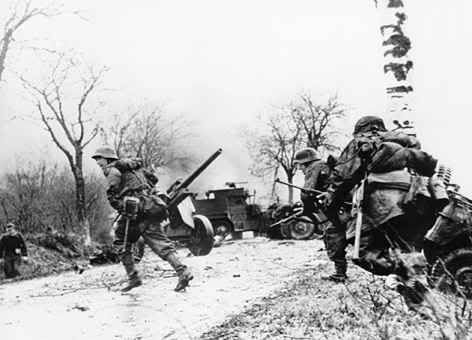
On December 16th, 1944, three German armies began an offensive along the Western Front, under cover of low clouds and fog. The Germans threw some 600 tanks into the attack, and aimed them at 3 American divisions (one veteran divison badly in need of rest and replacements after months of fighting, and 2 brand new, untried units) holding a quiet sector of the line in the Ardennes.
The German objective was ambitious, perhaps too ambitious given the resources available to them. The wooded Ardennes was to be crossed, pushing aside the American resistance, the River Meuse was to be crossed in the vicinity of Dinant, where the Germans had broken through in 1940, and the port of Antwerp was to be reached. If they got there, they would cut the Allied line in two, probably driving the Brits int he north into the sea. Taking Antwerp would also disrupt Allied logistical arrangements, as they were using the port to bring in supplies.
German secrecy had been impressive. Planning for the offensive began in September. Reserves of manpower, fuel, ammunition, and armored vehicles were carefully husbanded for it. All orders concerning the attack had been banned from radio traffic, and were delivered by hand of officer only.
The result was that the Allies were caught by surprise, since almost everyone thought the Wehrmacht was finished and that the war would soon be over. Eisenhower and Montgomery had a well-publicized 5 Pound bet on whether it would end by Christmas or not. Patton was due to begin an offensive south of the area the Germans attacked in a few days. Many senior officers were on leave, and the General Bradley had only the two American Airborne Divisions, the 82nd and 101st, in reserve, and both were refitting after having been committed too long to the fighting in Holland in September and October.
The Allies had been able to completely thwart all Geman efforts at an armored offensive, in large part because, with unchallenged air supremacy, Allied planes swooped down on attacking German formations with machine guns, bombs, and rockets, and took a heavy toll on German tanks, supply columns, and massed troops.
But the low clouds and fog meant (in 1944) that virtually no Allied planes were flying.
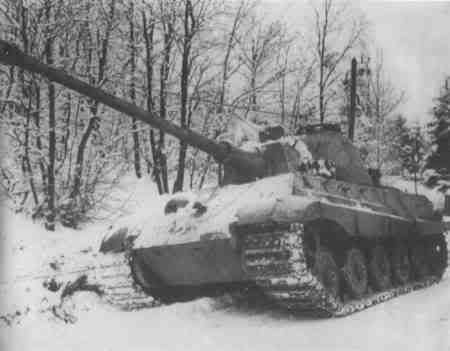
The Germans managed to penetrate the Allied line, though a stiff shoulder on the northern flank of the attack around Elsenborn Ridge and the villages of Krinklet and Rocherath held up progress. To the south, there was less in the way of natural lines of resistance, though a mixture of American units were holding a vital crossroads at Bastonge. Thus the German gains looked like a large "bulge" in the Allied line.
Bradley reacted slowly, but decisively. Patton was ordered to call off his offensive in the Saar, and get his units on the move north to drive into the German gains from the south. The 82nd Airborne was sent to help stiffen resistence around Elsenborn Ridge, and the 101st was committed to hold Bastonge. Montgomery ordered British units to backstop the Americans, holding a line on the far bank of the River Meuse.
The fighting around Bastonge, with the 101st going in virtually unarmed, and scrounging ammunition from the dead and wounded, and holding for more than a week (in fact, they moved very little in over a month of fighting), the pompous German demand for surrender, and the response from the acting diviisonal commander, Brig. McAuliffe, "Nuts!" is the stuff of which legends are made.
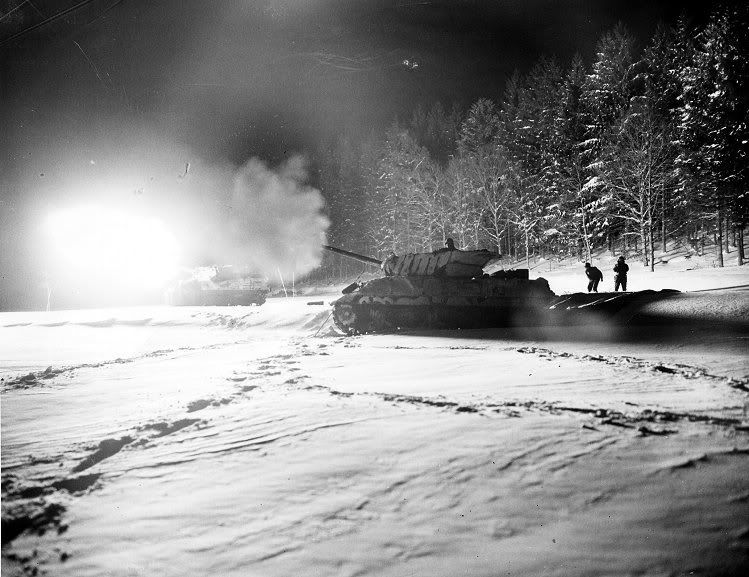
With Patton driving up from the south towards Bastonge, and every man who could carry a gun being scrapped out of billets behind the lines and made into combat infantry replacements, with the clearing of the skies for the Allied air forces shortly before Christmas, the tide turned against the Germans. The 2nd US Armored Division, with a lot of help from close air support from the Army Air Corps, stopped the German 2nd Panzer Division in the vicinity of Celles, a few miles from the Meuse.
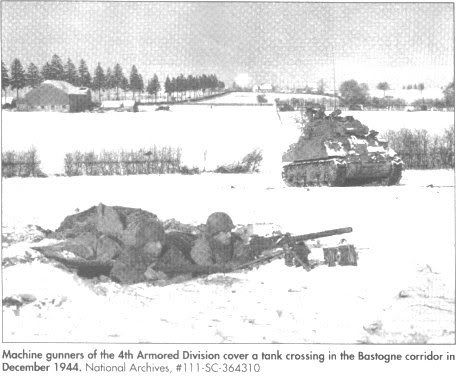
It took a month of very hard fighting, some of it in deep snow (though on December 16th, based on many photographs I have examined, the weather appears to have been raw with rain and fog, but no snow over most of the sector) before the Germans were made to slowly give back every square inch they gained in the first 5 days of the offensive.
What was the significance of the Battle of the Bulge?
It shortened the war considerably, since in using up his reserves in this attack, Hitler wasted an opportunity to use them to blunt the Russian winter offensive that carried them onto German soil, and eventually to Berlin itself. It turned the American soldiers, most of whom had had a relatively easy war since breaking out of Normandy, into first-rate soldiers, who met Hitler's best, and stopped them. And it showed, yet again, the importance of air power in modern warfare. The lack of air power allowed the Germans to make an impressive advance, and when that ability to utilize airpower was restored, the German gains were reversed.
Labels: American Patriotism Is Not A Sin
Sunday, July 04, 2010
Virtual Fireworks
Ok, it's not the same as the real thing. But I'm a July baby, and I love my fireworks.
Nothing could be more American than watching fireworks on July 4th. Yet, for many in remote areas, this is not practical. Your town may not be putting on a display this year because of budget constraints. Or you might not be able to get to the nearest fireworks display.
It is a tradition here at Recta Ratio to link to virtual fireworks displays you can enjoy in the comfort of your own study. So turn off the lights, crank up the volume on your speakers, plug some John Phillips Sousa, some Handel Water Music and Music for the Royal Fireworks, and some Williamsburg Corps of Fifes and Drums into the CD player, pour yourself some wine, and put some more mustard on that hot dog!
I always link to Hogpainter's fireworks display. For the record, I recently figured out that this is a guy who paints motorcycles. So "hogs" are motorcycles. Live and learn.
And try this one.
But you activate it by left-clicking the mouse within the field.
I like this one, too.
This one allows you to watch fireworks over the White House and over New York City, or at a carnival or baseball game.
This one over New York Harbor reminds me of the one 20 years ago (can it be that long?) when the Statue of Liberty was newly rehabbed and President Reagan came for the show and watched from the deck of USS Iowa. We surely need another Reagan now to set the country going again.
Happy Independence Day!
Nothing could be more American than watching fireworks on July 4th. Yet, for many in remote areas, this is not practical. Your town may not be putting on a display this year because of budget constraints. Or you might not be able to get to the nearest fireworks display.
It is a tradition here at Recta Ratio to link to virtual fireworks displays you can enjoy in the comfort of your own study. So turn off the lights, crank up the volume on your speakers, plug some John Phillips Sousa, some Handel Water Music and Music for the Royal Fireworks, and some Williamsburg Corps of Fifes and Drums into the CD player, pour yourself some wine, and put some more mustard on that hot dog!
I always link to Hogpainter's fireworks display. For the record, I recently figured out that this is a guy who paints motorcycles. So "hogs" are motorcycles. Live and learn.
And try this one.
But you activate it by left-clicking the mouse within the field.
I like this one, too.
This one allows you to watch fireworks over the White House and over New York City, or at a carnival or baseball game.
This one over New York Harbor reminds me of the one 20 years ago (can it be that long?) when the Statue of Liberty was newly rehabbed and President Reagan came for the show and watched from the deck of USS Iowa. We surely need another Reagan now to set the country going again.
Happy Independence Day!
Labels: American Patriotism Is Not A Sin
July 4th, 1776
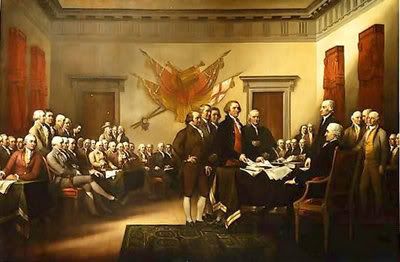
For those men who signed the Declaration of Independence on July 2nd, 1776, the odds did not look very good. Public opinion polls, if they existed, probably would have told them that only one-third of the population favored the course upon which they were about to embark. One-third was indifferent. One-third opposed independence. The men gathered from the thirteen colonies in Philadelphia, even without polling, probably had a sense that this was the case. After all, recruitment for the Continental Army was disappointing, and there had already been more than one pro-British uprising by loyalists.
The army which would be the primary instrument of winning independence was scarcely disciplined, poorly uniformed, badly armed, and ill-supplied with food and ammunition. Pay was a promise (which, in fact, was mostly ignored 7 years later). Its generals had no experience commanding larger bodies of troops than a battalion. Many found themselves commanding troops just because of political influence in their colonies.
True, there had been some victories. Boston had been rendered untenable for the enemy, and he had evacuated it. Fort Ticonderoga had fallen to a surprise attack, and supplied the heavy artillery that had led the British to evacuate Boston. Montreal had been captured, though that invasion force had been stopped at Quebec, and even now, after being rolled back within the boundaries of New York, was building an anti-invasion fleet on Lake Champlain. The delegates in Philadelphia probably did not know it, but an enemy invasion of Charleston, SC had been averted a few days before.
But there had also been defeats. Despite inflicting heavy losses on the enemy, Bunker Hill had been captured. The attempt to capture Canada had failed miserably.
Most significant was what was coming. As the delegates debated independence, they knew that the British army that had left Boston was en route from Halifax, probably heading for New York. If their spies were accurate, that army would rendezvous with another escorted by an even larger fleet. And those troops who had failed to capture Charleston were also heading to New York with a large fleet. Large numbers of British and German troops had driven the American Northern Army from Canada, and were poised to drive down Lake Champlain.
These troops who would confront their own tattered, inexperienced army were the best Europe could field. British troops who had conquered an empire just 15 years before would be joined by excellent troops from Brunswick and Hesse Cassel, Frederick the Great's best allies. The enemy was supported by professional artillerists, and by a navy that was (despite peacetime decline and corruption) still, ship-for-ship, the best in the world. Thousands of their fellow countrymen would be happy to take up arms alongside the British army. To make matters worse, the Indian nations were ready to take up arms on behalf of the King, raising the prospect of burned farms, scalped settlers, and women and children abducted into captivity among the savages.
The men in Philadelphia must have found the prospect of declaring independence a daunting task. In the next three months, the most likely outcome was that the British army would take New York, flatten their own army, and then march on Philadelphia to hang them for treason. Their property would be taken from their families. At best they would become fugitives constantly on the run from British authorities.
But the best of them had a vision for the future, and strong reasons to feel the need to break with the past, while preserving much of the societal and cultural heritage they had come into. The vision was that they would govern themselves, as they actually had for the most part, until the Imperial government decided to tap America for revenue to pay for keeping the peace with the Indians. John Winthrop's vision of a city set upon a hill remained a strong one, and merged with Locke's ideas about government, and newer ideas coming from Adam Smith about how an economy ought to be allowed to develop. A unified vision of a new nation which would serve as a beacon of liberty for all nations emerged, and was in the forefront of the minds of the men in Philadelphia. They had in this synthesis of ideas and in adapting to conditions on the American frontier, become a new nationality in need of a new nation.
And yet, despite all the obstacles, it was the vision that prevailed, and not the balance of forces. It is that vision that we celebrate today. John Adams, who did more than anyone to push the cause of independence through Congress, wrote to his wife that July 2, 1776 (the day the Declaration was approved):
"...Will be the most memorable epocha in the history of America. I am apt to believe that it will be celebrated by succeeding generations as the great anniversary festival. It ought to be commemorated as the Day of Deliverence by solemn acts of devotion to God Almighty. It ought to be solemnized with pomp and parade, with shows, games, sports, guns, bells, bonfires and illuminations from one end of this continent to the other from this time forward forever more."
May it always be so!
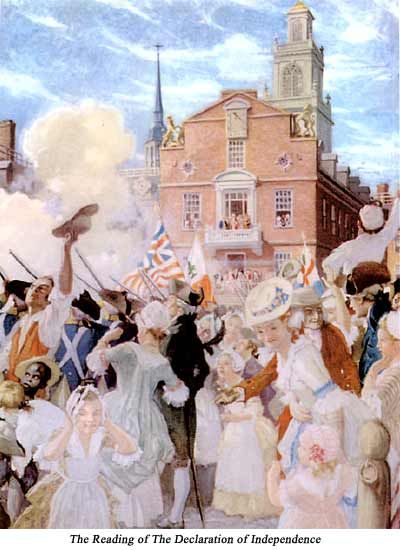
First reading of the Declaration of Independence at Boston's Old State House
Labels: American Patriotism Is Not A Sin
Monday, May 31, 2010
Memorial Day
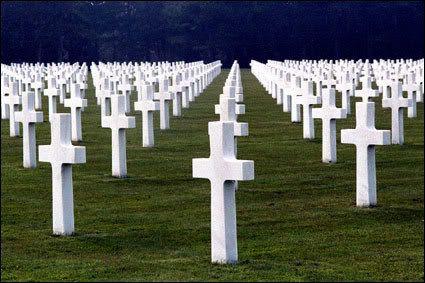
Four score and seven years ago our fathers brought forth on this continent, a new nation, conceived in Liberty, and dedicated to the proposition that all men are created equal.
Now we are engaged in a great civil war, testing whether that nation, or any nation so conceived and so dedicated, can long endure. We are met on a great battle-field of that war. We have come to dedicate a portion of that field, as a final resting place for those who here gave their lives that that nation might live. It is altogether fitting and proper that we should do this.
But, in a larger sense, we cannot dedicate, we cannot consecrate, we cannot hallow this ground. The brave men, living and dead, who struggled here, have consecrated it, far above our poor power to add or detract. The world will little note, nor long remember what we say here, but it can never forget what they did here. It is for us the living, rather, to be dedicated here to the unfinished work which they who fought here have thus far so nobly advanced. It is rather for us to be here dedicated to the great task remaining before us -- that from these honored dead we take increased devotion to that cause for which they gave the last full measure of devotion -- that we here highly resolve that these dead shall not have died in vain -- that this nation, under God, shall have a new birth of freedom -- and that government of the people, by the people, for the people, shall not perish from the earth.
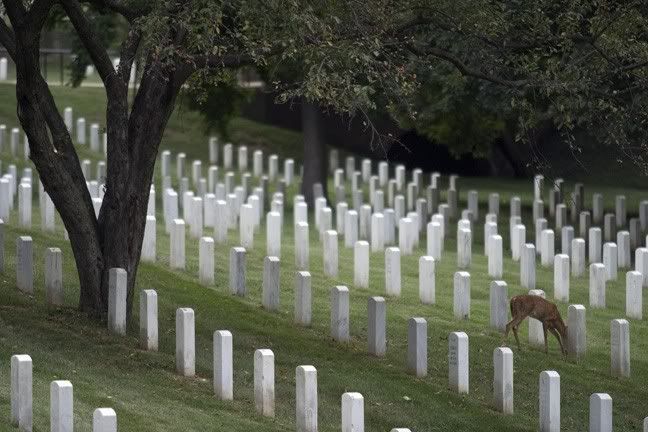
V. Requiem aeternam dona eis Domine
R. Et lux perpetua luceat in eis.
V. Requiescant in pace.
R. Amen.
Labels: American Patriotism Is Not A Sin
Monday, December 07, 2009
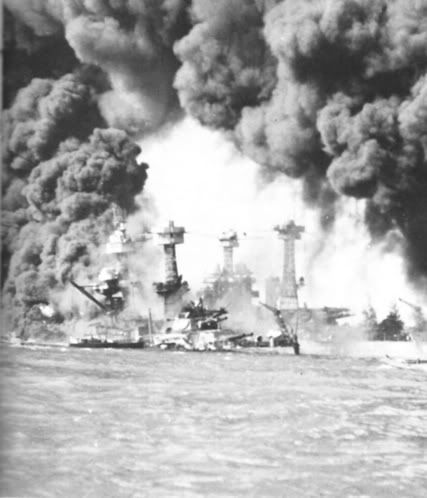
Pearl Harbor Anniversary
Wednesday, November 11, 2009
Veterans' Day 2009
My tribute to those who have served.
Thank you for your sacrifices!
Thank you for your sacrifices!
Labels: American Patriotism Is Not A Sin
Friday, September 11, 2009
Eight Years Later, The War Continues
The war against Islamo-fascist terrorism that began on September 11, 2001 continues on battlefields around the world.
We fight still in Afghanistan and Iraq openly with our armed forces. We fight everywhere else a clandestine war against those who have supported or do support our enemies in any way. We fight in every nation, including, especially, our own. We fight with bombs and missiles, infantry and tanks. We fight with reconnaissance drones and satellites. We fight with surveillance and wiretapping. We fight with infiltration and disinformation. We fight by aiding political forces favorable to us, and trying to nobble those against us. We fight with radio broadcasts, book publishing, and on the internet. We fight with money to good causes. We fight with cutting off funding to the enemy from the malinformed or ill-meaning.
We fight with persuasion. And where that doesn't work, we fight with a knife across the throat in a dark alley or with the cars of those who aid our enemy suddenly exploding. We fight everywhere and at all times. We fight in defense of the West, of Christendom, of the US, of capitalism, and of political liberality.
We do not weaken. We do not cut and run. We do not back down. We stay, and we fight. We have no other choice.
The war is not separable into distinct "wars" each requiring their own justification. It is all of a piece. The "war" in Iraq is as much a campaign in this larger war as the Campaign in Italy was part of World War II. Afghanistan is as much a campaign in this larger war as the Pacific Islands were a campaign of World War II.
There is much still to do. While Islamo-fascist violence in Iraq has diminished, it is not yet quelled. Afghanistan remains a problem. So too, does Iran, and Syria, and Libya. And then there are the power vacuums in Yemen and Pakistan, where government has with one hand helped the cause of order, and with the other aided the enemy quietly. The war won't be over until there are no wealthy benefactors ready to give to the enemy, until there is no government on earth supporting it in any way, until no one dares to bear arms in the Islamo-fascist cause.
Fortunately, we are not on entirely new ground here. Wars like this one have been fought and won before. Britain against Revolutionary and Napoleonic France. The US and the West against Soviet Communism. We have the examples before us, and only need to apply their lessons correctly.
It is not a glamorous war. There is little glory to be gained. But if we do not hang on and see the war through to its conclusion, no matter how many decades away that might be, we would not want to bequeath the world that would result to posterity. We are not the world's policeman. Instead, we are the world's garbage collectors. It is an appalling job. But if it isn't done (and no one else will do it) the filth will simply overwhelm us.
This is what happens when no one has taken out the trash for a long time:
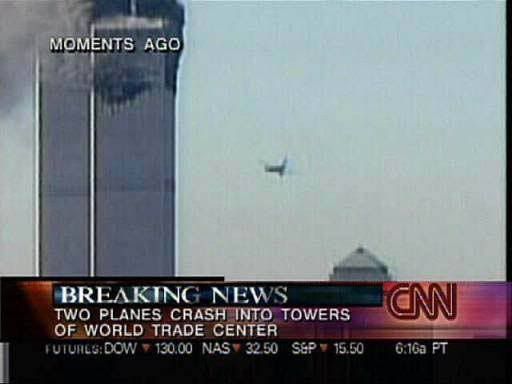
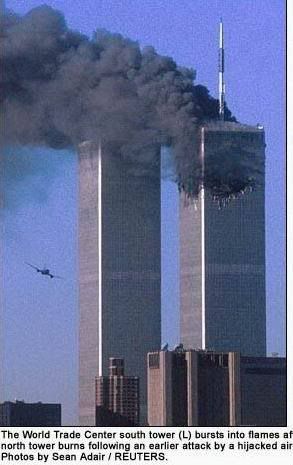
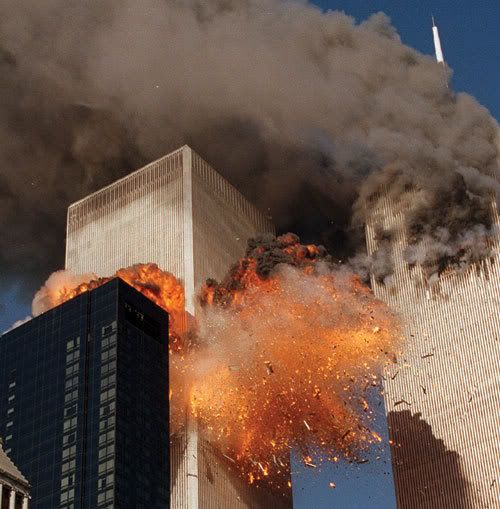
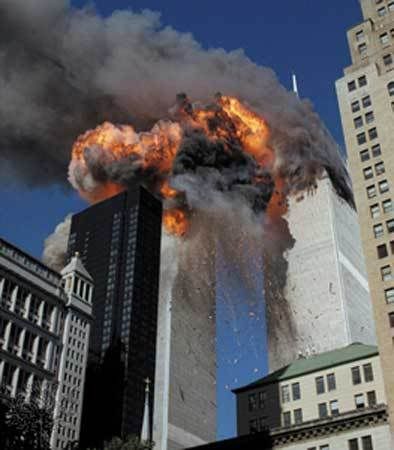
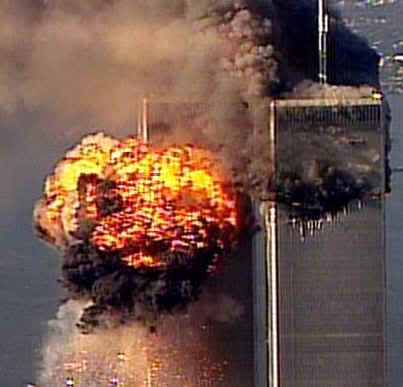
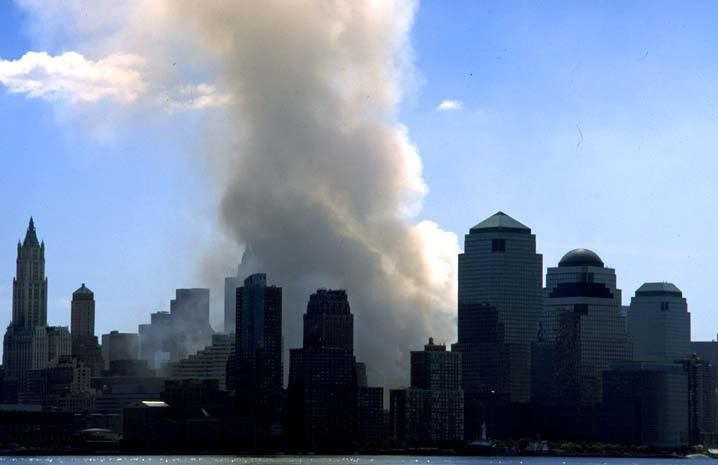
We pray for the poor souls murdered by the Islamo-fascist terrorists on September 11, 2001. We pause a moment and weep for those taken from their ordinary lives by air pirates and their supporters. We remember what the murderous bastards did to us on that day. We harden our hearts and gird our loins for the fight that remains.
And we do not fool ourselves into thinking the war is won, and that it is time to withdraw and tend to our domestic problems. We do not blow the trumpet that signals retreat. We may have elected particularly obtuse leaders last November, people who view national security policy the way fish view bicycles. But the American people know that is a war still to be waged and battles to be fought.
God bless our armed forces and God bless the USA!!!
We fight still in Afghanistan and Iraq openly with our armed forces. We fight everywhere else a clandestine war against those who have supported or do support our enemies in any way. We fight in every nation, including, especially, our own. We fight with bombs and missiles, infantry and tanks. We fight with reconnaissance drones and satellites. We fight with surveillance and wiretapping. We fight with infiltration and disinformation. We fight by aiding political forces favorable to us, and trying to nobble those against us. We fight with radio broadcasts, book publishing, and on the internet. We fight with money to good causes. We fight with cutting off funding to the enemy from the malinformed or ill-meaning.
We fight with persuasion. And where that doesn't work, we fight with a knife across the throat in a dark alley or with the cars of those who aid our enemy suddenly exploding. We fight everywhere and at all times. We fight in defense of the West, of Christendom, of the US, of capitalism, and of political liberality.
We do not weaken. We do not cut and run. We do not back down. We stay, and we fight. We have no other choice.
The war is not separable into distinct "wars" each requiring their own justification. It is all of a piece. The "war" in Iraq is as much a campaign in this larger war as the Campaign in Italy was part of World War II. Afghanistan is as much a campaign in this larger war as the Pacific Islands were a campaign of World War II.
There is much still to do. While Islamo-fascist violence in Iraq has diminished, it is not yet quelled. Afghanistan remains a problem. So too, does Iran, and Syria, and Libya. And then there are the power vacuums in Yemen and Pakistan, where government has with one hand helped the cause of order, and with the other aided the enemy quietly. The war won't be over until there are no wealthy benefactors ready to give to the enemy, until there is no government on earth supporting it in any way, until no one dares to bear arms in the Islamo-fascist cause.
Fortunately, we are not on entirely new ground here. Wars like this one have been fought and won before. Britain against Revolutionary and Napoleonic France. The US and the West against Soviet Communism. We have the examples before us, and only need to apply their lessons correctly.
It is not a glamorous war. There is little glory to be gained. But if we do not hang on and see the war through to its conclusion, no matter how many decades away that might be, we would not want to bequeath the world that would result to posterity. We are not the world's policeman. Instead, we are the world's garbage collectors. It is an appalling job. But if it isn't done (and no one else will do it) the filth will simply overwhelm us.
This is what happens when no one has taken out the trash for a long time:
We pray for the poor souls murdered by the Islamo-fascist terrorists on September 11, 2001. We pause a moment and weep for those taken from their ordinary lives by air pirates and their supporters. We remember what the murderous bastards did to us on that day. We harden our hearts and gird our loins for the fight that remains.
And we do not fool ourselves into thinking the war is won, and that it is time to withdraw and tend to our domestic problems. We do not blow the trumpet that signals retreat. We may have elected particularly obtuse leaders last November, people who view national security policy the way fish view bicycles. But the American people know that is a war still to be waged and battles to be fought.
God bless our armed forces and God bless the USA!!!
Labels: American Patriotism Is Not A Sin, er
Saturday, July 04, 2009
Virtual Fireworks
Ok, it's not the same as the real thing. But I'm a July baby, and I love my fireworks.
Nothing could be more American than watching fireworks on July 4th. Yet, for many in remote areas, this is not practical. Your town may not be putting on a display this year because of budget constraints. Or you might not be able to get to the nearest fireworks display.
It is a tradition here at Recta Ratio to link to virtual fireworks displays you can enjoy in the comfort of your own study. So turn off the lights, crank up the volume on your speakers, plug some John Phillips Sousa, some Handel Water Music and Music for the Royal Fireworks, and some Williamsburg Corps of Fifes and Drums into the CD player, pour yourself some wine, and put some more mustard on that hot dog!
I always link to Hogpainter's fireworks display. For the record, I just last year figured out that this is a guy who paints motorcycles. So "hogs" are motorcycles. Live and learn.
And try this one.
But you activate it by left-clicking the mouse within the field.
I like this one, too.
This one allows you to watch fireworks over the White House and over New York City, or at a carnival or baseball game.
This one over New York Harbor reminds me of the one 20 years ago (can it be that long?) when the Statue of Liberty was newly rehabbed and President Reagan came for the show and watched from the deck of USS Iowa.
Happy Independence Day!
Nothing could be more American than watching fireworks on July 4th. Yet, for many in remote areas, this is not practical. Your town may not be putting on a display this year because of budget constraints. Or you might not be able to get to the nearest fireworks display.
It is a tradition here at Recta Ratio to link to virtual fireworks displays you can enjoy in the comfort of your own study. So turn off the lights, crank up the volume on your speakers, plug some John Phillips Sousa, some Handel Water Music and Music for the Royal Fireworks, and some Williamsburg Corps of Fifes and Drums into the CD player, pour yourself some wine, and put some more mustard on that hot dog!
I always link to Hogpainter's fireworks display. For the record, I just last year figured out that this is a guy who paints motorcycles. So "hogs" are motorcycles. Live and learn.
And try this one.
But you activate it by left-clicking the mouse within the field.
I like this one, too.
This one allows you to watch fireworks over the White House and over New York City, or at a carnival or baseball game.
This one over New York Harbor reminds me of the one 20 years ago (can it be that long?) when the Statue of Liberty was newly rehabbed and President Reagan came for the show and watched from the deck of USS Iowa.
Happy Independence Day!
Labels: American Patriotism Is Not A Sin
July 4th, 1776
For those men who signed the Declaration of Independence on July 2nd, 1776, the odds did not look very good. Public opinion polls, if they existed, probably would have told them that only one-third of the population favored the course upon which they were about to embark. One-third was indifferent. One-third opposed independence. The men gathered from the thirteen colonies in Philadelphia, even without polling, probably had a sense that this was the case. After all, recruitment for the Continental Army was disappointing, and there had already been more than one pro-British uprising by loyalists.
The army which would be the primary instrument of winning independence was scarcely disciplined, poorly uniformed, badly armed, and ill-supplied with food and ammunition. Pay was a promise (which, in fact, was mostly ignored 7 years later). Its generals had no experience commanding larger bodies of troops than a battalion. Many found themselves commanding troops just because of political influence in their colonies.
True, there had been some victories. Boston had been rendered untenable for the enemy, and he had evacuated it. Fort Ticonderoga had fallen to a surprise attack, and supplied the heavy artillery that had led the British to evacuate Boston. Montreal had been captured, though that invasion force had been stopped at Quebec, and even now, after being rolled back within the boundaries of New York, was building an anti-invasion fleet on Lake Champlain. The delegates in Philadelphia probably did not know it, but an enemy invasion of Charleston, SC had been averted a few days before.
But there had also been defeats. Despite inflicting heavy losses on the enemy, Bunker Hill had been captured. The attempt to capture Canada had failed miserably.
Most significant was what was coming. As the delegates debated independence, they knew that the British army that had left Boston was en route from Halifax, probably heading for New York. If their spies were accurate, that army would rendezvous with another escorted by an even larger fleet. And those troops who had failed to capture charleston were also heading to New York with a large fleet. Large numbers of British and German troops had driven the American Northern Army from Canada, and were poised to drive down Lake Champlain.
These troops who would confront their own tattered, inexperienced army were the best Europe could field. British troops who had conquered an empire just 15 years before would be joined by excellent troops from Brunswick and Hesse Cassel, Frederick the Great's best allies. The enemy was supported by professional artillerists, and by a navy that was (despite peacetime decline and corruption) still, ship-for-ship, the best in the world. Thousands of their fellow countrymen would be happy to take up arms alongside the British army. To make matters worse, the Indian nations were ready to take up arms on behalf of the King, raising the prospect of burned farms, scalped settlers, and women and children abducted into captivity among the savages.
The men in Philadelphia must have found the prospect of declaring independence a daunting task. In the next three months, the most likely outcome was that the British army would take New York, flatten their own army, and then march on Philadelphia to hang them for treason. Their property would be taken from their families. At best they would become fugitives constantly on the run from British authorities.
But the best of them had a vision for the future, and strong reasons to feel the need to break with the past. The vision was that they would govern themselves, as they actually had for the most part, until the Imperial government decided to tap America for revenue to pay for keeping the peace with the Indians. John Winthrop's vision of a city set upon a hill remained a strong one, and merged with Locke's ideas about government, and newer ideas coming from Adam Smith about how an economy ought to be allowed to develop. A unified vision of a new nation which would serve as a beacon of liberty for all nations emerged, and was in the forefront of the minds of the men in Philadelphia. They had in this synthesis of ideas and in adapting to conditions on the American frontier, become a new nationality in need of a new nation.
And yet, despite all the obstacles, it was the vision that prevailed, and not the balance of forces. It is that vision that we celebrate today. John Adams, who did more than anyone to push the cause of independence through Congress, wrote to his wife that July 2, 1776 (the day the Declaration was approved):
"...Will be the most memorable epocha in the history of America. I am apt to believe that it will be celebrated by succeeding generations as the great anniversary festival. It ought to be commemorated as the Day of Deliverence by solemn acts of devotion to God Almighty. It ought to be solemnized with pomp and parade, with shows, games, sports, guns, bells, bonfires and illuminations from one end of this continent to the other from this time forward forever more."
May it always be so!
First reading of the Declaration of Independence at Boston's Old State House
Labels: American Patriotism Is Not A Sin