Monday, April 18, 2011
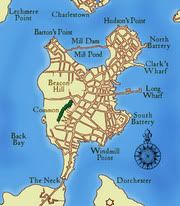
Patriots' Day 2011


Labels: American Patriotism Is Not A Sin, American Revolution, New England Things, Once A Redcoat...
Monday, July 12, 2010
Currently Reading
How I have missed reading regularly! Seven years ago I blew through 120 books in about 7 months. Normally, I am a book-a-week reader, maybe one every other week if I am slacking. But in the last couple of years, my reading has slowed to less than a crawl, due to fatigue, and time constraints. I just barely get through my Lenten spiritual reading, which is admittedly more than most people read all year. The deaths of favorite authors Patrick O'Brian and William F. Buckley, Jr. have also hit my reading hard. Dead authors write no new books, and how many times can you re-read Treason's Harbour?
But there is a book that I have been waiting for in paperback for a couple of years, and now that it is out, I am all over it. Matthew H. Spring, a teacher from England, penned his doctoral dissertation on the topic of how the British Army really fought in the American War Of Independence. In hardcover, as a university press imprint, it is ridiculously expensive, but the trade paper edition, at $20.00 is a great value.
With Zeal And With Bayonets Only: The British Army On Campaign In North America 1775-1783 is a truly groundbreaking study that shatters popular assumptions and forces revision of the most elemental approach to understanding how the AWI was fought.
Spring demonstrates that, from the earliest campaigns, the British Army adapted to North American conditions to the extent that they turned conventional linear warfare norms on their head and essentially threw the book away. Thin lines, loose formations, firing at will, command and control devolved to battalion and comany level leadership, and staking it all on a quick rush with the bayonet, instead of the traditional battle-as-extended-firefight that was common on the continent were how the British Army, principally at the hands of General Sir William Howe, adapted.

The adaptation was so complete that, in many battles, it was Washington's army that operated slowly, in closely packed ranks, while the redcoats fanned out, took cover, and then settled the matter not by a slugging match of volley after volley (even though they could outshoot the rebel troops by about 2 volleys to 1) but with a quick bayonet charge at a run. The Americans criticized the redcoats for disordered ranks, and the professional Hessian officers were frustrated by the speed at which the redcoats operated (at least twice leaving their Hessian comrades far behind).
The Brits, for their part, found the Hessians with their shoulder-to-shoulder formation, 3 ranks, and slow marching step, far too slow, though they admitted their steadiness. And they held the American rebels in such contempt that they sometimes resorted to ruthless tactics, like bayoneting overwhelmed rebels.
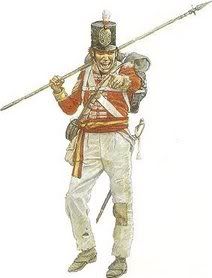
What does the book teach me, as a former reenactment officer and what might loosely be classified as an expert on the military operations of the British Army? A lot. The unit I played in was an "April 19th" unit, which represented the British Army on the first day of the war. A great deal of what we did was thrown out by the end of 1775, and was utterly obsolete by August 1776. By then, the entire army was forming at open, and even extended order (or two-deep line with 18-inch intervals between files, as Spring quotes again and again). Rapidity of volley firing, which had been the hallmark of British troops in the Seven Years War, and would be again under Wellington, was thrown out, with the emphasis placed on getting off one strong battalion volley at close range, then rushing on the unsteady enemy with fixed bayonets. Speed, speed, speed, or celerity, is talked about again and again. Keeping step and dressing was often disregarded in favor of getting at the rebels quickly. Ceremonial, the slow march, and the presence of the Colours on campaign were stripped away in favor of speed, dexerity with the firelock, and plying the bayonet in such a manner as to make the enemy give way, or be "totally skivered."
There are now four works of modern scholarship that I think are essential for anyone wishing to portray a British soldier of the American War Of Independence. The first is Christopher Duffy's magesterial survey of 18th century warfare and the experience of battle, The Military Experience In the Age of Reason. But remember that much of the norms that Duffy discusses were thrown out the window by Generals Howe, Clinton, Burgoyne, and Cornwallis. The second is Sylvia Frey's social study of who the British redcoats really were, The British Soldier In America. The third is J.A. Houlding's Fit For Service: The Training Of the British Army 1715-1793. You cannot say too much in praise of Houlding's scholarship and the comprehensive treatment he gives to the actual circumstances that hemmed in training.
Now Matthew Spring's With Zeal And With Bayonets Only takes its place as THE resource for understanding how the redcoats fought the war. It has greatly expanded my own perspective.
But there is a book that I have been waiting for in paperback for a couple of years, and now that it is out, I am all over it. Matthew H. Spring, a teacher from England, penned his doctoral dissertation on the topic of how the British Army really fought in the American War Of Independence. In hardcover, as a university press imprint, it is ridiculously expensive, but the trade paper edition, at $20.00 is a great value.
With Zeal And With Bayonets Only: The British Army On Campaign In North America 1775-1783 is a truly groundbreaking study that shatters popular assumptions and forces revision of the most elemental approach to understanding how the AWI was fought.
Spring demonstrates that, from the earliest campaigns, the British Army adapted to North American conditions to the extent that they turned conventional linear warfare norms on their head and essentially threw the book away. Thin lines, loose formations, firing at will, command and control devolved to battalion and comany level leadership, and staking it all on a quick rush with the bayonet, instead of the traditional battle-as-extended-firefight that was common on the continent were how the British Army, principally at the hands of General Sir William Howe, adapted.

The adaptation was so complete that, in many battles, it was Washington's army that operated slowly, in closely packed ranks, while the redcoats fanned out, took cover, and then settled the matter not by a slugging match of volley after volley (even though they could outshoot the rebel troops by about 2 volleys to 1) but with a quick bayonet charge at a run. The Americans criticized the redcoats for disordered ranks, and the professional Hessian officers were frustrated by the speed at which the redcoats operated (at least twice leaving their Hessian comrades far behind).
The Brits, for their part, found the Hessians with their shoulder-to-shoulder formation, 3 ranks, and slow marching step, far too slow, though they admitted their steadiness. And they held the American rebels in such contempt that they sometimes resorted to ruthless tactics, like bayoneting overwhelmed rebels.
What does the book teach me, as a former reenactment officer and what might loosely be classified as an expert on the military operations of the British Army? A lot. The unit I played in was an "April 19th" unit, which represented the British Army on the first day of the war. A great deal of what we did was thrown out by the end of 1775, and was utterly obsolete by August 1776. By then, the entire army was forming at open, and even extended order (or two-deep line with 18-inch intervals between files, as Spring quotes again and again). Rapidity of volley firing, which had been the hallmark of British troops in the Seven Years War, and would be again under Wellington, was thrown out, with the emphasis placed on getting off one strong battalion volley at close range, then rushing on the unsteady enemy with fixed bayonets. Speed, speed, speed, or celerity, is talked about again and again. Keeping step and dressing was often disregarded in favor of getting at the rebels quickly. Ceremonial, the slow march, and the presence of the Colours on campaign were stripped away in favor of speed, dexerity with the firelock, and plying the bayonet in such a manner as to make the enemy give way, or be "totally skivered."
There are now four works of modern scholarship that I think are essential for anyone wishing to portray a British soldier of the American War Of Independence. The first is Christopher Duffy's magesterial survey of 18th century warfare and the experience of battle, The Military Experience In the Age of Reason. But remember that much of the norms that Duffy discusses were thrown out the window by Generals Howe, Clinton, Burgoyne, and Cornwallis. The second is Sylvia Frey's social study of who the British redcoats really were, The British Soldier In America. The third is J.A. Houlding's Fit For Service: The Training Of the British Army 1715-1793. You cannot say too much in praise of Houlding's scholarship and the comprehensive treatment he gives to the actual circumstances that hemmed in training.
Now Matthew Spring's With Zeal And With Bayonets Only takes its place as THE resource for understanding how the redcoats fought the war. It has greatly expanded my own perspective.
Labels: Once A Redcoat...